


Welcome to this week’s VCR! All counties continue to trend above their 10 year average GDD.
Crop Updates
Brassica Crops – Cutworm damage is being found in many different crops and Brassicas are no exception. Damage found on the lower leaves of plants with no sign of lepidopteran pests may be the result of early-morning slug feeding. Stunted plants with red leaves and girdled crowns are likely due to wirestem / Rhizoctonia infection. Continue to scout for imported cabbageworm, cabbage looper, diamondback moths, tarnished plant bugs and aphids. If wilted plants are found, dig up the transplant and inspect the root ball for cabbage maggot larvae.
Carrots – With most of the acreage planted, we’re at a critical timing for weed control. Use the Ontario Crop Protection Hub to know what pre-emerge and post-emerge products are available for carrots: Weed control search (gov.on.ca)
Using pre-emerge products are important to reduce the reliance on Lorox.
Aster leafhopper infectivity testing out of Michigan State University has consistently been very high this spring. Our aster yellows incidence tracks very closely with Michigan from year to year so growers should be prepared to manage leafhoppers this season. Use orange sticky cards to monitor flushes of leafhoppers into the field. Check the Ontario Crop Protection Hub to see products registered for use on carrots.
Celery – Transplants are establishing well. Scout for leaf damage caused by tarnished plant bug. Dig up wilted plants and inspect the roots for cutworm larvae, nematode cysts, or carrot weevil larvae.
Garlic – Now that scapes have emerged, plants are showing tip dieback / yellowing of the leaves. Scapes should be removed as soon as possible for the best yield potential. Lots of leek moth larvae feeding damage has been reported over the past week. An article on how to monitor leek moths can be found here: https://onvegetables.com/2023/05/17/leek-moth/. If using Bt to control leek moth, apply the product on cloudy days or in the evening to avoid UV degradation.
Onions – The largest direct seeded onions are reaching the 6th leaf stage while most fields are still around the 4th leaf stage. Cutworm damage is sporadic, with some fields are showing high amounts of damage this year. Monitor for thrips and dig up wilted plants to confirm onion maggot damage. Low levels of thrips are starting to be observed. Past research has shown that Movento 240 SC (group 23) has some residual activity that works better against larvae when it is applied twice earlier in the season. Once the spray threshold has been met, Movento 240 SC could be followed by two applications of Delegate (group 5) or Agri-Mek (group 6). Using a penetrating surfactant can be useful to maximize the effectiveness of products against thrips. Apply no more than two consecutive insecticides from the same IRAC crop as thrips have a relatively short life cycle with multiple generations through the summer months and are at a high risk of developing insecticide resistance.
Peppers – Pepper planting is still ongoing, and growers should ensure they are finished planting by June 20th is they want crop insurance for this season. Growers in 2-generation and overlap European corn borer areas should be on the look-out for the pest as the first peak is has begun Kent county and in the London and Sarnia areas. Though the second peak will be more worrisome as the plants will have fruit at that time, there are many control options available for growers in need. Always make sure to read all product labels before any pest control product application.
Potatoes – Early planted potatoes have had excellent growing conditions and some fields are in full flower.

High incidence of cutworms are being reported across the province this year. In potatoes, damage will show as clipped off stems near the soil surface (Figure 2) and in some cases large, ragged feeding holes on the leaves (Figure 3). Cutworms feed at night and then bury themselves in the soil during the day. The curled-up cutworm larvae in Figure 3 was found by digging in the top 1-2 inches of soil around the damaged plants.


For more information on cutworms see the Ontario Crop IPM entries: Black cutworm, Variegated cutworm
Follow the link to see Registered products for cutworms in potatoes
Because of our relatively cool and wet start to the season, seed rot and emergence issues are being reported.
On emerged plants, blackleg causes stunted, yellowing, wilted plants with leaves cupping upwards (Figure 4). The stems will be inky black (Figure 5) and generally smelly.


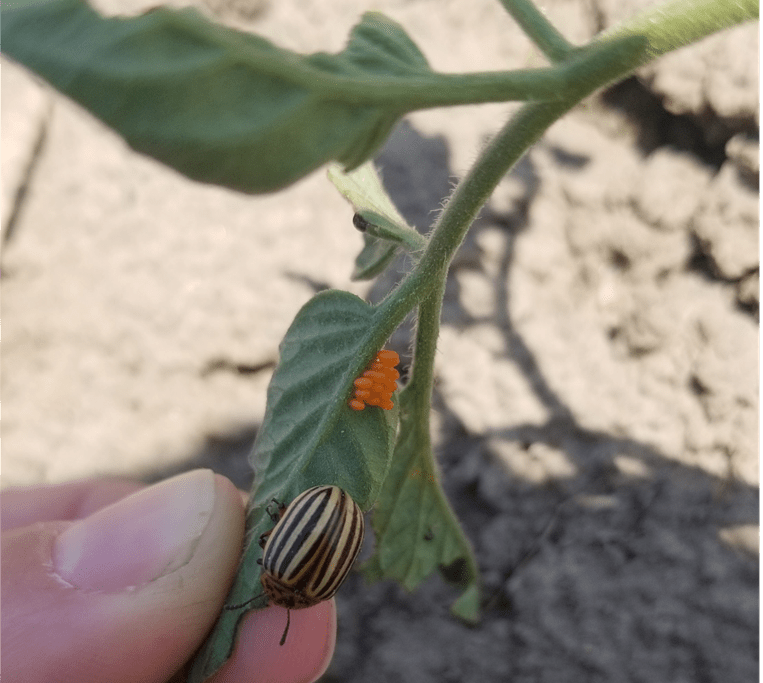
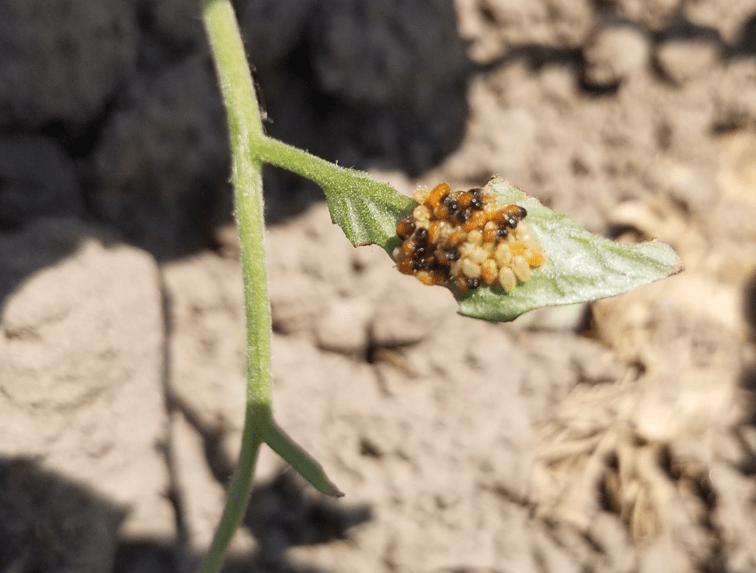
Tomatoes – Planting is wrapping up for processing tomatoes. Growers should still be looking out for Colorado potato beetle (CPB). Since losing key in-furrow insecticide products a few years ago, the potential for significant damage to young plants is higher. CPB is critical to manage during the transplant phase as the adults (Figure 6) and larva (Figure 7) can cause significant defoliation of plants, often leading to plant death. There are a few foliar products that growers can use for CPB control, but you will need multiple applications to control these early populations. Target adults when you start seeing damage, then follow-up with another spray, using a product from a different insecticide group, 5-7 days later once eggs have begun to hatch (Figure 7). Continue to monitor for CPB and damage as additional applications may be needed. Be sure to read all product labels thoroughly before any pest control product application and follow resistance management strategies. CPB are known to be resistant to group 1 insecticides in many parts of Ontario.
Pest Degree Day Forecasting
| County | Carrot Rust Fly | Onion Maggot | Carrot Weevil | Aster Leafhopper | Tarnished Plant Bug | Cabbage Maggot | Seedcorn Maggot | European Corn Borer |
| THRESHOLD | 329-395, 1399-1711 | 210-700, 1025-1515 | 138-156, 455+ | 128+ | 40+ | 314-398, 847-960, 1446-1604 | 200-350, 600-750, 1000-1150 | See legend below |
| Bruce*** | 632 | 553 | 353 | 241 | 113 | 413 | 553 | 194 |
| Essex* | 937 | 846 | 601 | 463 | 278 | 678 | 846 | 399 |
| Chatham-Kent* | 847 | 760 | 530 | 402 | 227 | 601 | 760 | 339 |
| Norfolk** | 791 | 703 | 467 | 339 | 179 | 540 | 703 | 281 |
| Huron*** | 714 | 630 | 408 | 287 | 152 | 477 | 630 | 233 |
| Wellington Centre** | 689 | 606 | 396 | 280 | 139 | 459 | 606 | 228 |
| Wellington North** | 672 | 592 | 384 | 272 | 139 | 448 | 592 | 220 |
| Simcoe*** | 659 | 580 | 375 | 260 | 128 | 438 | 580 | 207 |
| Durham*** | 727 | 643 | 423 | 302 | 155 | 491 | 643 | 248 |
| Peterborough | 668 | 586 | 377 | 259 | 123 | 442 | 586 | 209 |
| Kemptville*** | 732 | 649 | 445 | 331 | 187 | 506 | 649 | 279 |
| Sudbury*** | 538 | 472 | 305 | 212 | 104 | 357 | 472 | 170 |
| Timiskaming*** | 518 | 458 | 301 | 213 | 111 | 349 | 458 | 173 |
| Lambton** | 821 | 737 | 507 | 378 | 218 | 579 | 737 | 319 |
| Thunder Bay | 400 | 339 | 187 | 113 | 35 | 231 | 339 | 82 |
| Middlesex** | 835 | 748 | 513 | 382 | 218 | 586 | 748 | 324 |
| Renfrew | 724 | 644 | 441 | 332 | 192 | 503 | 644 | 282 |
*- Bivoltine region for ECB. First Peak Catch: 300-350 DD, Second Peak Catch 1050-1100 DD
**- Overlap region for ECB. First Peak Catch: 300-350 DD Second Peak Catch 650-700 DD, Third Peak Catch 1050-1100 DD
***-Univoltine region for ECB. Peak Catch 650-700 DD
Use these thresholds as a guide, always confirm insect activity with actual field scouting and trap counts
Select a region below for the latest weather, crop and pest degree day information:
Norfolk


Essex


Sudbury


Chatham-Kent


Peterborough


Huron


Durham


Thunder Bay


Bruce


Kemptville


Lambton


Middlesex


Renfrew


Simcoe


Wellington Centre


Wellington North


Timiskaming

