


Welcome back to the next VCR of 2024!
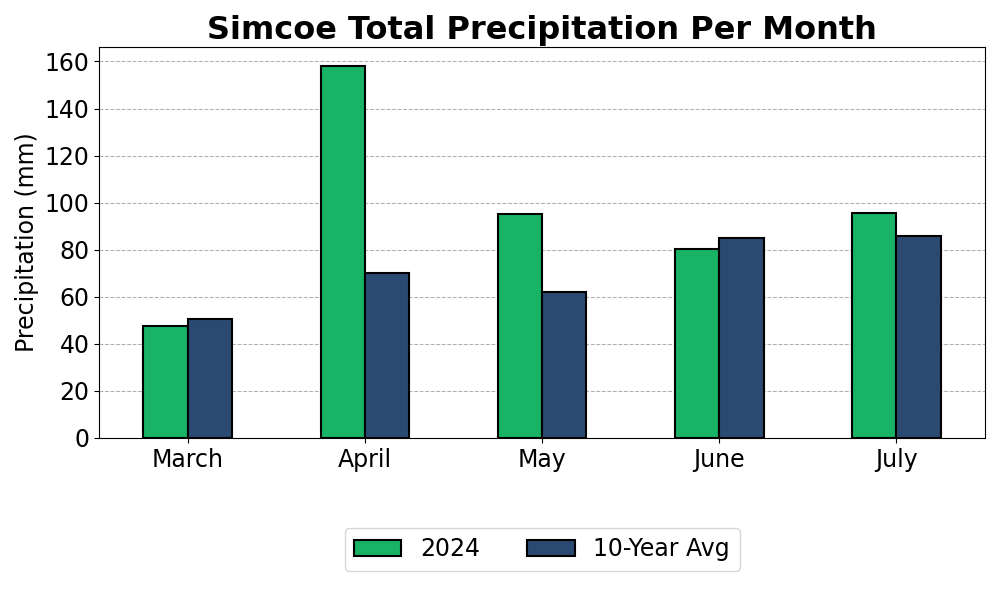
Many counties have continued to experience heavy precipitation over the last week. Counties such as Durham, Lambton, Middlesex, Norfolk, Peterborough, Simcoe, and Wellington Centre have already received more precipitation this July than their ten-year average for the month.
Almost all counties continue to trend above their 10 year average GDD, with the exception of Thunder Bay which is on trend with its 10 year average.
Crop Updates
Beans – prolonged leaf wetness, accompanied by lush, full crop canopies provide the ideal environment for white mould (sclerotinia) (Figure 1). Apply a preventative fungicide at early bloom and again 7 days later. Keep an eye on the pre-harvest interval as many products have a 14-day PHI. Spent blossoms are usually the main point of entry for this disease. Thorough spray coverage into the canopy is important.

Brassica Crops – Given all the precipitation over the past couple of weeks, some fields are showing symptoms of nutrient imbalances which have resulted in tip dieback, leaf edema and/or sun scorch. The conditions have also been favourable the past month for Alternaria and Sclerotinia white rot and they have shown up in multiple fields at various stages of crop development. Sclerotinia will start as white mycelial growth followed by small, black spots/spores that look like mouse droppings within the fluffy white growth (Figure 2). These black spores can overwinter in the soil for up to 8 years and the best preventative management strategy is to rotate with non-susceptible crops such as beets, onions, spinach, corn, cereals or grasses. Once the crop is harvested, incorporate residue as soon as possible to reduce inoculum for future years. Managing chewing insects will also reduce the spread of Sclerotinia.

Cucurbits – consider the next few weeks a peak disease management period for all cucurbit crops. For cucumbers, the key disease is still downy mildew. Unless foliar symptoms of other diseases begin to appear, there is not a strong benefit to adding additional fungicides to the program. For pumpkins and squash the primary target is powdery mildew. Keep in mind that there is documented powdery mildew resistance to the group 11 (QoI) fungicides. Scout fields regularly for signs or symptoms of other foliar diseases such as alternaria, anthranose or gummy stem blight. Ontario Crop IPM is a great resource for scouting and identification information. https://cropipm.omafra.gov.on.ca/
Garlic – Harvest continues across the province in areas that are dry enough for machinery to enter the field. Remove bulbs from direct sunlight as soon as possible and be mindful of how long garlic is sitting in wagons/crates when there is no forced air present. Remove excess moisture from the crop as soon as possible as a slow cure will make it easy for pathogens to colonize wounds / bruises from harvest which will lower quality and the length of time the crop can be kept in storage. Be vigilant about reducing mechanical injury during harvest.
Onions – Many fields are still green to the tip, but most fields are showing some Stemphylium lesions by now (Figure 3). Onion downy mildew is spreading to new fields and a protective fungicide should be applied if one has not been applied already. Past work by the Ontario Crops Research Centre – Bradford has shown that Orondis Ultra (groups 40/49), Zampro (groups 45/40) and Orondis Gold (Groups 4/49) are effective at protecting the crop against downy mildew. A full list of products registered for onion downy mildew can be found on the Ontario Crop Protection Hub. More onions are showing symptoms of bacterial rots, especially in fields that have seen excessive amounts of rainfall over the past week.

Sweet corn – western bean cutworm activity is on the rise. Adults will typically select pre-tassel field corn fields in which to lay eggs. Sweet corn is less attractive to them. However, it is a good idea to scout for egg masses (Figure 4) in fields of pre-tasseling stages. Reports out of the US have indicated a low to moderate risk of corn earworm moth flights into the Great Lakes region at this time. Take note of any weather patterns originating in the SW United States and protect corn at the silking stages.

Pest Degree Day Forecasting
| County | Carrot Rust Fly | Onion Maggot | Carrot Weevil | Aster Leafhopper | Tarnished Plant Bug | Cabbage Maggot | Seedcorn Maggot | European Corn Borer |
| THRESHOLD | 329-395, 1399-1711 | 210-700, 1025-1515 | 138-156, 455+ | 128+ | 40+ | 314-398, 847-960, 1446-1604 | 200-350, 600-750, 1000-1150 | See legend below |
| Bruce*** | 1174 | 1060 | 758 | 578 | 348 | 853 | 1060 | 497 |
| Chatham-Kent* | 1506 | 1385 | 1049 | 851 | 571 | 1155 | 1385 | 754 |
| Durham*** | 1331 | 1213 | 891 | 703 | 453 | 993 | 1213 | 614 |
| Essex* | 1628 | 1502 | 1152 | 944 | 654 | 1264 | 1502 | 845 |
| Huron*** | 1269 | 1152 | 831 | 644 | 410 | 933 | 1152 | 558 |
| Kemptville*** | 1363 | 1245 | 937 | 752 | 503 | 1032 | 1245 | 665 |
| Lambton** | 1472 | 1353 | 1018 | 819 | 554 | 1126 | 1353 | 725 |
| Middlesex** | 1424 | 1304 | 973 | 779 | 518 | 1079 | 1304 | 689 |
| Norfolk** | 1436 | 1313 | 971 | 773 | 508 | 1079 | 1313 | 680 |
| Peterborough | 1254 | 1138 | 827 | 642 | 404 | 926 | 1138 | 557 |
| Renfrew | 1360 | 1244 | 937 | 758 | 513 | 1033 | 1244 | 673 |
| Simcoe*** | 1275 | 1160 | 847 | 660 | 420 | 945 | 1160 | 571 |
| Sudbury*** | 1093 | 992 | 720 | 557 | 344 | 806 | 992 | 480 |
| Thunder Bay | 879 | 782 | 525 | 382 | 200 | 604 | 782 | 316 |
| Timiskaming*** | 1074 | 979 | 716 | 558 | 353 | 800 | 979 | 484 |
| Wellington Centre** | 1290 | 1172 | 857 | 671 | 425 | 955 | 1172 | 584 |
| Wellington North** | 1272 | 1157 | 844 | 661 | 423 | 943 | 1157 | 575 |
*- Bivoltine region for ECB. First Peak Catch: 300-350 DD, Second Peak Catch 1050-1100 DD
**- Overlap region for ECB. First Peak Catch: 300-350 DD Second Peak Catch 650-700 DD, Third Peak Catch 1050-1100 DD
***-Univoltine region for ECB. Peak Catch 650-700 DD
Use these thresholds as a guide, always confirm insect activity with actual field scouting and trap counts
Select a region below for the latest weather, crop and pest degree day information:
Bruce


Chatham-Kent


Durham


Essex


Huron


Kemptville


Lambton


Middlesex


Norfolk


Peterborough


Renfrew


Simcoe

Sudbury


Thunder Bay


Timiskaming


Wellington Centre


Wellington North

