
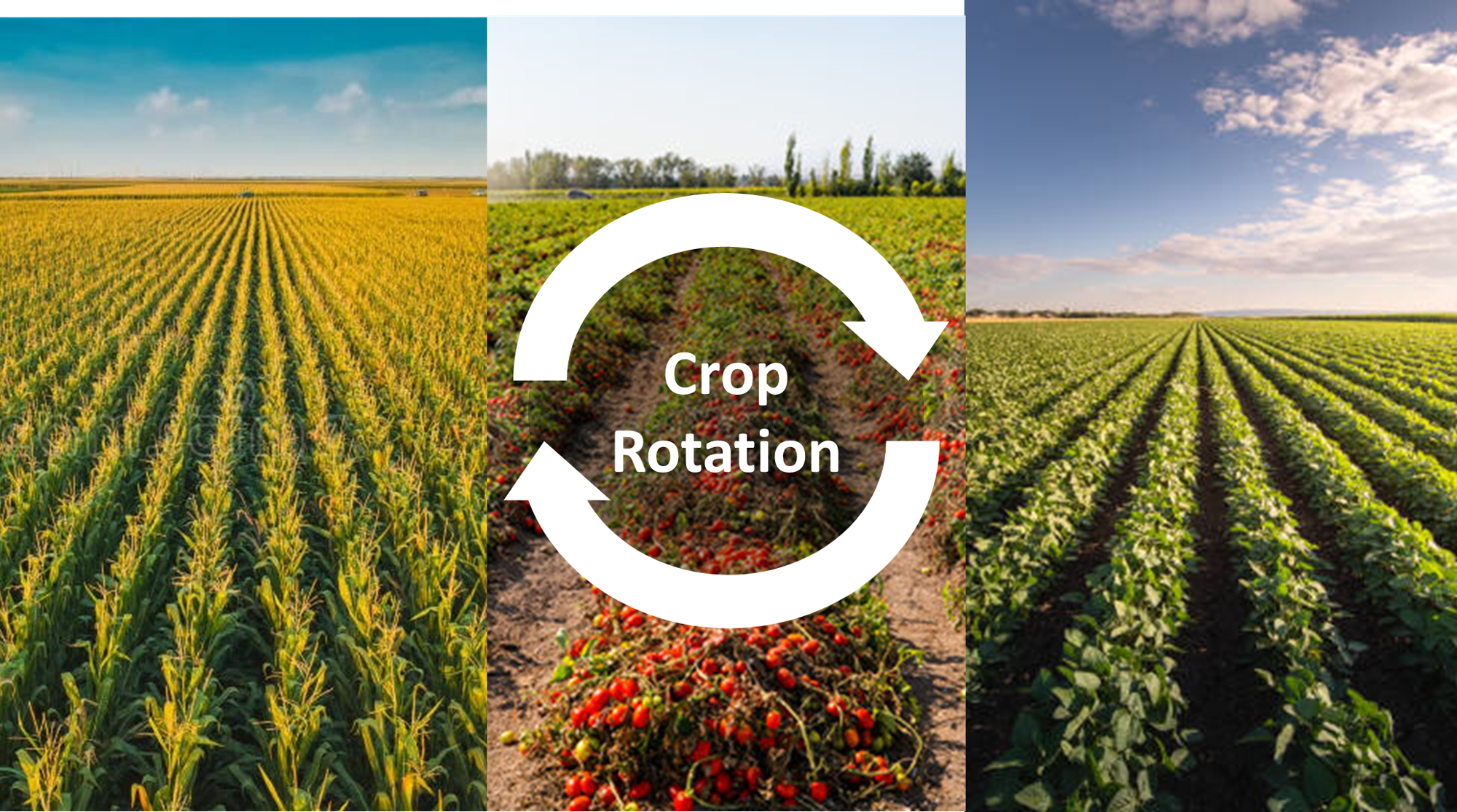
The practice of rotating different crops on the same field over time is ancient (dating back millennia!), but it has never been more relevant. As we become more aware of the importance of soil health and integrated pest management, crop rotation remains a simple and efficient tool to promote both. It helps keep farms productive, resilient, and sustainable in the long run.
The idea is simple: instead of planting the same crop year after year, you sequence crops across seasons and years. This is effective on multiple levels:
- Lowering pest pressure: Many pests and pathogens tend to target specific crops. By rotating to a different crop, you disrupt their life cycle and reduce their chances of surviving and multiplying.
- Improving soil health: Different crops have different root structures and nutrient needs. Rotating them helps balance nutrient use and improve soil structure. Some crops even boost organic matter or fix nitrogen (like legumes), making the soil more fertile and resilient over time.
- Boosting productivity: Rotating crops helps cut down on input costs by reducing the need for fertilizers and pesticides. Plus, it leads to better yields. AAFC research showed that corn and soybean yields increased by 40-50% in diverse rotations compared to continuous monoculture.
There is no such thing as an ideal rotation for everyone, as it depends on your goals and the specific conditions and history of the farm. However, there are some key principles that you should keep in mind when designing your rotation strategy:
1) Plant families
It’s better to rotate across different plant families, not just different crops. For example, while tomatoes and bell peppers are different crops, they both belong to the same plant family (Solanaceae) and therefore share similar pests and diseases (like anthracnose).
Some pathogens can survive in crops outside their preferred plant family, even if they don’t cause major damage in those crops. For example, Phytophthora infestans, the causal agent of late blight in tomatoes and potatoes (both Solanaceae), can persist in legumes like snap beans. So, in this case, rotating to a cereal crop (like corn or wheat), which is more distantly related, would be a better choice to reduce pest populations.
Another good example is cabbage root maggots, which tend to attack primarily Brassica crops. So if you have recurrent outbreaks of maggots in your cabbage fields, including a non-Brassica crop in your rotation would be a smart way to break the pest cycle and reduce future pressure.

2) Pest history
Keep track of which pests have been an issue in specific fields. While some pests are specialists that target specific plant families and can be managed more easily with rotation, others are generalists and can affect a wide range of crops.
For example, wireworms, the larvae of click beetles, are generalist pests that can attack crops from multiple plant families, making it harder to manage through rotation alone. They build up in fields with grass crops, pasture, or weedy vegetation, and can remain in the soil for 5–6 years before maturing.
Similarly, Fusarium species are common root-rot pathogens that can survive in a broad range of hosts. This means that simply switching to a different plant family may not be enough to significantly lower populations.
In these cases, rotation planning should not focus only on changing crop families but also on integrating other control methods that target the pest’s weak points. For example, wireworm management can be improved by including non-preferred-host crops for which there are effective insecticide options, combined with extended rotations of 4–5 years or more. For soilborne diseases like Fusarium, pairing rotation with resistant varieties, improved drainage, and organic matter management can be more effective than rotation alone.
3) Cover crops
Incorporating cover crops in a rotation system can have many benefits: improving soil health, reducing erosion, suppressing weeds, and supporting nutrient cycling between cash crop seasons.
Choosing the right species depends on their role, timing, and how they fit into your rotation. Fast-growing species like buckwheat can suppress weeds in summer, while winter rye provides reliable ground cover during colder months. Legumes are useful for nitrogen fixation and can be especially valuable before planting crops with high nitrogen demand.
Remember that all the other factors mentioned (plant families, pest history, and duration) also apply to cover crops. For instance, following a snap bean field, it is more effective to plant a cereal cover crop like winter wheat rather than another legume such as red clover, which may host similar pathogens.
Even when options are limited, planting any cover crop is better than leaving the soil bare, as it helps protect and maintain the soil until the next crop is planted.
4) Duration
The length of your rotation cycle can make a big difference. While 2–3-year rotations are common, such as corn → soybean → wheat, longer rotations tend to deliver greater benefits. A 4-5-year minimum is recommended.
Research shows that longer and more diverse rotations provide more significant improvements in yield, soil health, and pest control. And it’s not just about the length of the cycle, it’s also about consistency. The longer you’ve been rotating, the more resilient your system becomes and the greater the yield gains.
It’s important to note that some soilborne pathogens, such as Phytophthora capsici or clubroot (Plasmodiophora brassicae), can persist in the soil for over 10 years. Crop rotation alone will not eliminate these pathogens, but it can still help reduce inoculum levels and slow disease buildup when combined with other management practices.
Designing a balanced rotation
Crop rotation works best when it’s approached with flexibility. Start small by focusing on your most vulnerable or high-value crops, and build a rotation plan that considers plant families, pest history, and soil needs.
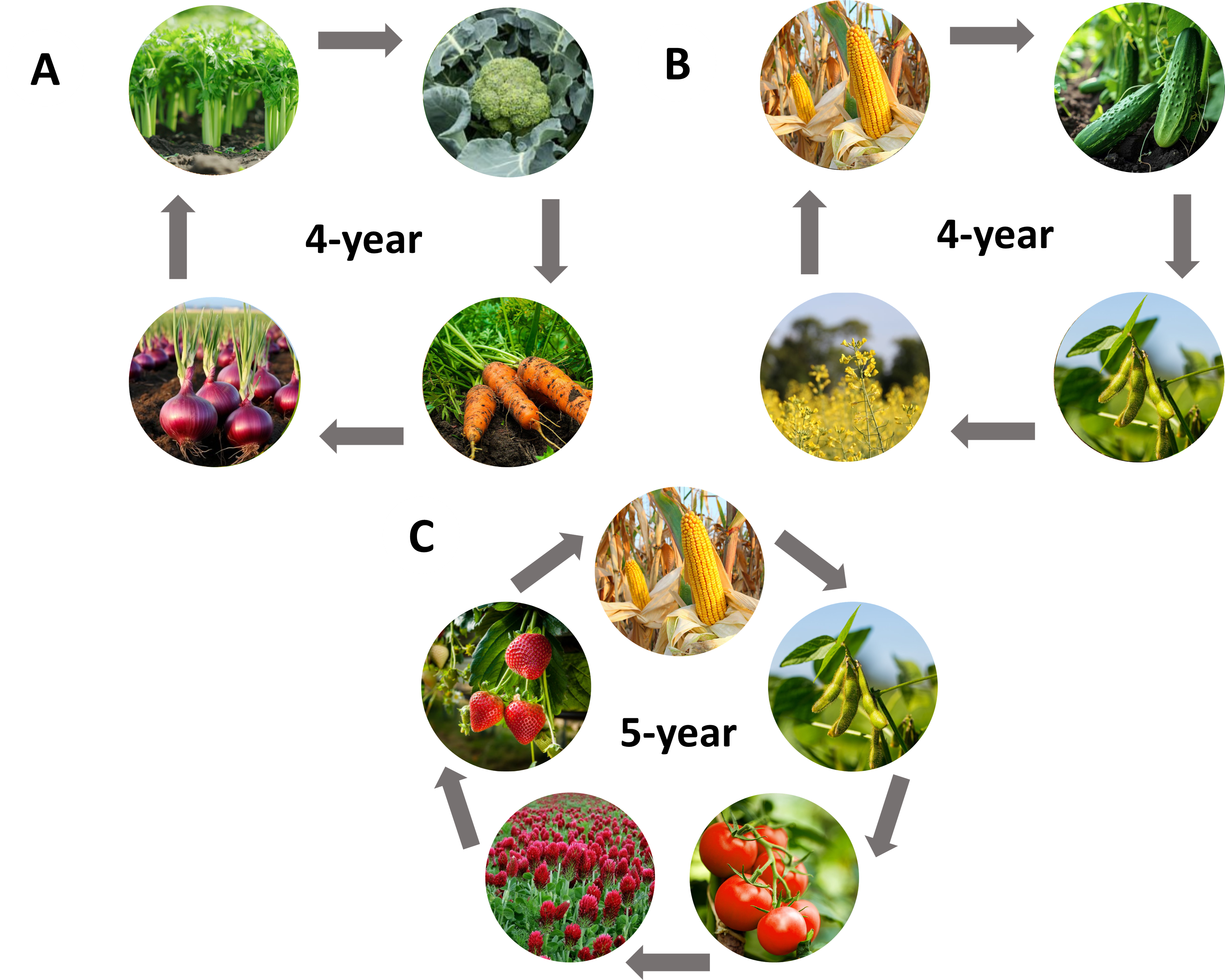
For annual systems, effective rotations can be done exclusively with horticultural crops (Figure 1A), provided fruiting vegetables (solanaceous and cucurbits) are not planted back-to-back, as they share many pathogens.
Alternatively, integrating horticultural crops with field crops helps balance revenue and increase diversity (Figure 2B–C). In this case, a strong rotation includes four key elements: a main horticultural crop, a cereal, a legume, and a cover crop. Cereals improve soil structure and organic matter through added biomass, while legumes naturally supply nitrogen, reducing fertilizer needs and enhancing fertility.
Here are few examples of efficient rotations:
These are general guidelines, not rigid rules. Every farm’s rotation plan will depend on its primary crop, local conditions, equipment, and markets. It can take a few seasons of trial and error to figure out what works best for your system, but each adjustment will move you closer to a healthier and more resilient farm.
This article was written by Caio Correa (acting Plant Pathologist, OMAFA) with input from various specialists:
- Katie Goldenhar (Plant Pathologist, OMAFA)
- Hannah Fraser (Entomologist, OMAFA)
- Stephanie Vickers (Soil Management Specialist, OMAFA)
- Travis Cranmer (Vegetable Crop Specialist , OMAFA)
- Amanda Tracey (Vegetable Crop Specialist, OMAFA)
- Elaine Roddy (Vegetable Crop Specialist, OMAFA)
- Erica Pate (Fruit Crop Specialist, OMAFA)
0 comments on “Why crop rotation works and how to make it better? ”