
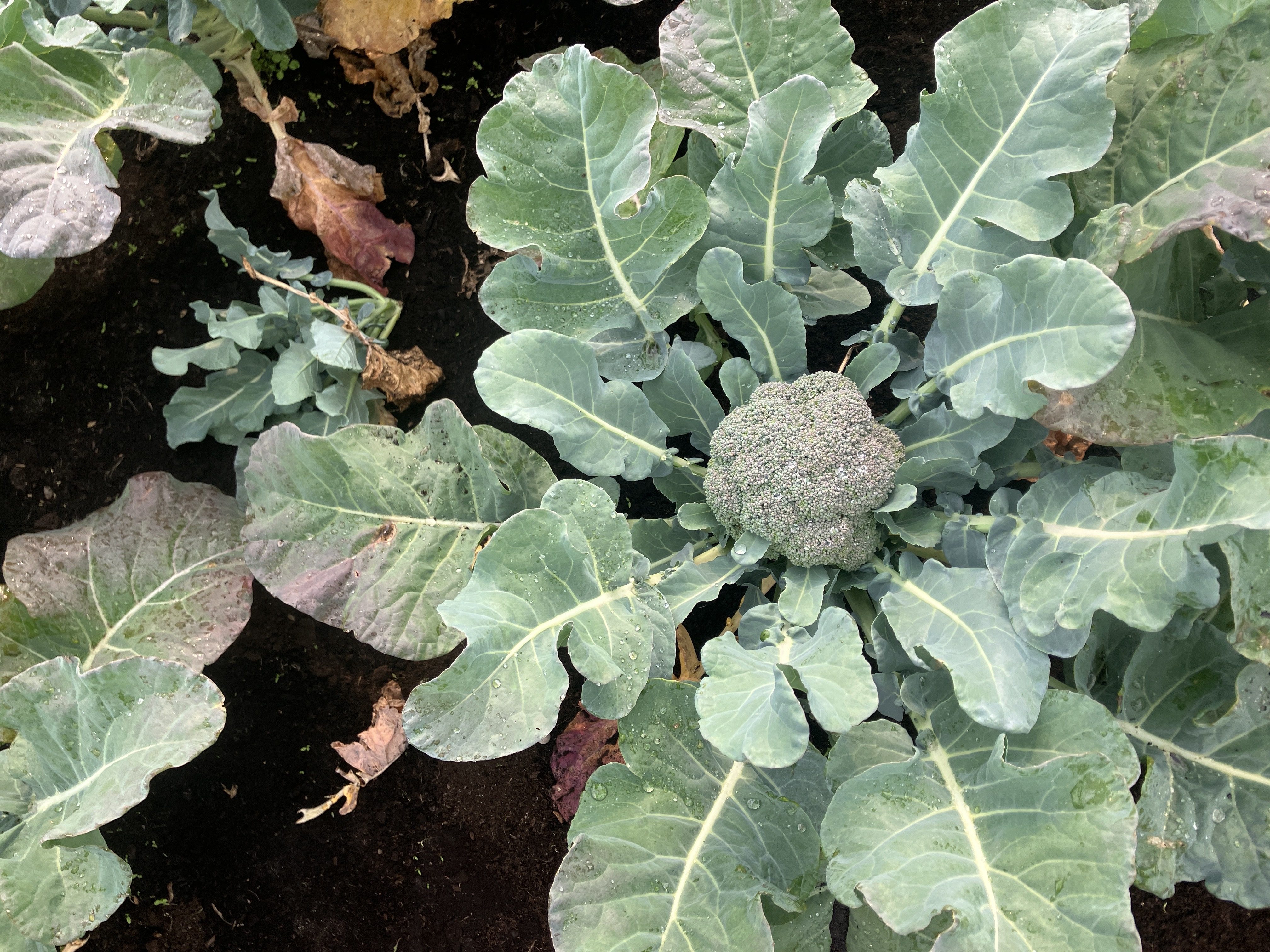
Alternaria leaf spot and head rot has become increasingly difficult to manage in Brassica vegetable crops grown in Canada. Brassica greens that are marketed for the leaves have zero tolerance for Alternaria lesions. On cabbage and Brussels sprouts, lesions on the buds make the crop unmarketable and while the leaves of broccoli and cauliflower are not sold, Alternaria spores can cause black streaking on the curds and florets and results in an entry point for secondary pathogens (Figure 1).
Based on a 2023 survey of Ontario commercial Brassica vegetables, several Alternaria species have been associated with disease symptoms. Alternaria alternata, A. brassicae, A. brassicicola, A. arborescens and A. tenuissima, with A. brassicicola being the most common species detected in 66% of the samples (N=67).
Seeds of many Brassica crops can be infested with Alternaria spores that may be suppressed by a fungicide or a hot water seed treatment. Weeds in the Brassicacaea family can also harbour this fungus, spreading disease to Brassica crops by wind. Prolonged periods of leaf wetness at 15-25°C (59-77°F) promote infection. High humidity and temperatures greater than 14°C (57°F) favour spore development.

Management strategies can reduce the amount of inoculum in the field. Incorporate crop debris as soon as possible. The fungus overwinters on crop debris and the sooner infected leaves are below ground to break down, the less chance that they will serve as inoculum in a yet to be harvested crop.
When overhead irrigating, choose to irrigate in the early morning when the crop is already covered in droplets of dew, and you are not extending the period of leaf wetness any further.
In broccoli, consider spacing plants further apart to allow for better air circulation. Choose broccoli cultivars with a dome head that sheds water droplets after rain. Excess moisture helps Alternaria spores germinate and those spores punch holes in the cells of the florets. These infections may act as entry points for bacterial pathogens to infect the heads and ultimately reduce storability.
Historically, Alternaria management has relied greatly on broad spectrum control from the fungicide chlorothalonil. Chlorothalonil (Bravo ZN and similar products) was re-evaluated in 2018 and the number of applications allowed on head and stem Brassicas like broccoli, Brussels sprouts, cabbage, and cauliflower decreased from five to one application per season.
The fungicide resistance action committee (FRAC) outlines resistance management recommendations based on the fungicide group (how it targets the pathogen) and the number of applications being used to control a disease (amount of selection pressure). FRAC groups 3, 7, and 11 fungicides are all single site inhibitors and are inherently more susceptible to resistance development than multisite fungicides like chlorothalonil. According to the FRAC, group 7 and 11s are classified as a high risk of fungi, like Alternaria species, developing resistance. To reduce the selection pressure, FRAC group 7 products in a spray program should not make up more than three total applications throughout the field season.
Table 1 outlines what is currently registered on cabbage, broccoli, Brussels sprouts, cauliflower for Alternaria leaf spot in Canada. Some products with duplicate FRAC groups were excluded from this table since they are only registered on cabbage. If FRAC guidelines are followed and a different FRAC group is applied in subsequent applications, a total of 11 fungicides applications is the most that can be applied per season if Alternaria management is required. For long season crops like Brussels sprouts and storage cabbage, this leaves several weeks of the crop without protection and if conditions are favourable, can lead to yield loss.

In addition to limited availability of different fungicide groups, some Alternaria species are potentially becoming resistant to group 11 fungicides. In the 2023 species survey, all isolates were tested for the G143A genetic mutation that can confer resistance to group 11 fungicides as a result of an amino acid substitution of glycine by alanine at the 143 position. This mutation is known to occur in many fungi but is not the only mutation that can allow fungi to become resistant, for example, Alternaria solani (causal agent of early blight in tomatoes and potatoes) resistance to group 11s is attributed through the F129L mutation. The majority of Alternaria alternata, A. arborescens and A. tenuissima isolates were positive for the G143A mutation. The most common Alternaria species associated with Brassica Alternaria disease, A. brassicicola and A. brassicae, were negative for this mutation. This means that if your field has a predominate population of A. brassicicola or A. brassicae, group 11’s may still be effective, however more work is needed to know if there is another mutation present in these isolates.
There are other fungicides that are in various stages of registration with the PMRA that could provide control if registered in Canada and provide alternative fungicide groups for resistance management. Adavelt (florylpicoxamid, group 21), Allegro 500F (fluazinam, group 29) and the FRAC group M4 fungicides, folpet or captan, would offer control which could help reduce the risk of resistance to single site fungicides in group 3, 7 and 11.
During this past field season, a field fungicide efficacy trial conducted at the University of Guelph Ontario Crops Research Centre – Bradford showed promising results for Allegro 500F and Folpan 500 SC. In this trial, all fungicide treatments, which included fungicides in group 3, 7 and 11, provided a significant reduction in the number of lesions on leaves and improved the marketability of the heads (Figure 2). The trial was inoculated with isolates of A. brassicicola. The final report from the 2024 broccoli Alternaria fungicide trial can be downloaded here and the results can also be viewed as a poster at the Ontario Fruit and Vegetable Convention (OFVC).

With limited fungicide options available and marketability being highly affected by Alternaria diseases, Brassica vegetables are becoming a difficult crop to grow. Depending on how conducive the field season is for disease development, a significant amount of acreage is lost every year due to Alternaria fungi.
For more information on Alternaria disease management in Brassica vegetables, attend the OFVC Brassica Alternaria session the morning of Wednesday, February 19, 2025.
0 comments on “Alternaria is becoming a major concern for Brassica growers”