


Welcome back to the next VCR of 2025!
Currently most counties are slightly above their 10 year average GDD, with Norfolk, Sudbury, Timiskaming, and Thunder Bay trending at their 10 year average.
Crop Updates
Brassica Crops – Transplanting for late broccoli has finished. Alternaria is starting to show in some fields. Alternaria can cause head rot in broccoli and cauliflower if spores are able to infect the beads/curds and secondary bacteria can cause rot. With the hot and dry weather, be on the lookout for symptoms of black rot –Xanthamonas campestris pv. campestris (Figure 1). Black rot spreads rapidly during warm weather and fields with overhead irrigation. The bacterial cells enter through wounds or natural openings on the leaf tips. The Xanthamonas bacteria often finds it’s way to farms in infected seeds and then bacterial cells overwinter on used trays, propagation equipment and crop debris for up to three years. Infected plants have characteristic ‘v’ shaped lesions and systemically infected plants have chlorotic areas anywhere on the leaf. When leaves are held up to the sun, veins filled with Xanthamonas bacteria are stained black in the chlorotic areas on the leaf. The best management strategy is prevention through certified clean seed, sanitation of propagation equipment/tools, a four-year crop rotation, and rogueing and then burying all crop debris. To read more about black rot, refer to CropIPM.

Garlic – Stained bulb wrappers on bulbs headed to storage may be due to Pseudomonas (Figure 2). To reduce symptoms of Pseudomonas next year;
- Shorten cure time by removing excess moisture from the crop as quickly as possible using dehumidifiers
- Rogue out cloves with missing bulb wrappers, brown streaking or fat necks and do not use them as planting stock
- Avoid poorly drained fields and plant in raised beds if there are concerns of flooding in any part of the growing season
- Avoid planting in headlands or areas that are in the shade; shade results in extended periods of leaf wetness periods which result in better conditions for bacterial development
- Implement a 4-year crop rotation
- Avoid overhead irrigation; utilize drip irrigation instead
- Avoid applications of nitrogen after the 5th leaf stage


Onion – Transplants continue to be harvested and direct seeded onions are starting to lodge. Stemphylium leaf blight and tipburn is starting to take hold in direct seeded fields but the level of Stemphylium lesions to other years is lower. Royal MH can be applied for sprout control when 50% of the crop has lodged and there are green tops that are still present to absorb the product. Apply at least 10 days before the crop is harvested. Now is a great time to assess damage plots that were put up in the spring. Determining the number of plants that survived out of the 100 germinated/transplanted plants that were counted at the start of the season is valuable information to determine what percentage of plants died due to onion maggot, drought, or some other pest.
Peppers – Phytophthora remains a concern for pepper growers even though the season has been dry and generally not conducive to disease development. Check wilting plants for crown and stem lesions and brown, unhealthy roots. Affected areas of the field can be tilled under to help minimize the spread of fresh spores. We are also approaching the final peak of European corn borer (ECB) in most areas of the province and have reached the beginning of the final peak in Essex County. Growers should be gearing up to spray an insecticide to protect fruit. FRAC group 28 and 3A products are a good option for ECB control in peppers.
Tomatoes – Tomatoes are looking very good in most growing regions of the province. Early varieties are ready for harvest which will begin on August 15th. On August 7, 2025 late blight was observed in tomatoes in Middlesex county Ontario. Growers should remain aware of the risk in the area by staying up to date on blog posts. Growers should continue with their general fungicide program and consider late blight specific fungicides only if there are symptoms in the field or in a field very nearby.
Phytophthora capsici is still a concern in most growing areas in Southwestern Ontario. Growers should be on the look out for wilting plants, buckeye rot on green fruit and red fruit turning into “water balloons”, especially in lower areas of the fields. There are some control options that can help to protect the remaining fruit.
Pest Degree Day Forecasting
| County | Carrot Rust Fly | Onion Maggot | Carrot Weevil | Aster Leafhopper | Tarnished Plant Bug | Cabbage Maggot | Seedcorn Maggot | European Corn Borer |
| THRESHOLD | 329-395, 1399-1711 | 210-700, 1025-1515 | 138-156, 455+ | 128+ | 40+ | 314-398, 847-960, 1446-1604 | 200-350, 600-750, 1000-1150 | See legend below |
| Bruce*** | 1583 | 1451 | 1082 | 865 | 580 | 1199 | 1451 | 766 |
| Chatham-Kent* | 1935 | 1789 | 1376 | 1133 | 807 | 1506 | 1789 | 1018 |
| Durham*** | 1804 | 1669 | 1291 | 1057 | 750 | 1414 | 1669 | 948 |
| Essex* | 2057 | 1909 | 1489 | 1235 | 889 | 1624 | 1909 | 1115 |
| Huron*** | 1723 | 1585 | 1204 | 980 | 683 | 1325 | 1585 | 877 |
| Kemptville*** | 1797 | 1663 | 1283 | 1050 | 748 | 1406 | 1663 | 945 |
| Lambton** | 1882 | 1737 | 1333 | 1095 | 781 | 1463 | 1737 | 986 |
| Middlesex** | 1901 | 1758 | 1355 | 1110 | 789 | 1484 | 1758 | 997 |
| Norfolk** | 1831 | 1688 | 1284 | 1044 | 734 | 1413 | 1688 | 934 |
| Peterborough | 1702 | 1567 | 1187 | 961 | 663 | 1309 | 1567 | 857 |
| Renfrew | 1805 | 1674 | 1299 | 1072 | 775 | 1421 | 1674 | 968 |
| Simcoe*** | 1728 | 1593 | 1221 | 995 | 705 | 1340 | 1593 | 894 |
| Sudbury*** | 1417 | 1303 | 979 | 787 | 527 | 1083 | 1303 | 698 |
| Thunder Bay | 1278 | 1167 | 856 | 665 | 412 | 954 | 1167 | 576 |
| Timiskaming*** | 1382 | 1268 | 952 | 763 | 502 | 1053 | 1268 | 673 |
| Wellington Centre** | 1687 | 1551 | 1172 | 946 | 652 | 1295 | 1551 | 843 |
| Wellington North** | 1681 | 1548 | 1171 | 955 | 663 | 1291 | 1548 | 854 |
*- Bivoltine region for ECB. First Peak Catch: 300-350 DD, Second Peak Catch 1050-1100 DD
**- Overlap region for ECB. First Peak Catch: 300-350 DD Second Peak Catch 650-700 DD, Third Peak Catch 1050-1100 DD
***-Univoltine region for ECB. Peak Catch 650-700 DD
Use these thresholds as a guide, always confirm insect activity with actual field scouting and trap counts
Select a region below for the latest weather, crop and pest degree day information:
Bruce


Chatham-Kent


Durham


Essex


Huron


Kemptville


Lambton


Middlesex


Norfolk


Peterborough


Renfrew


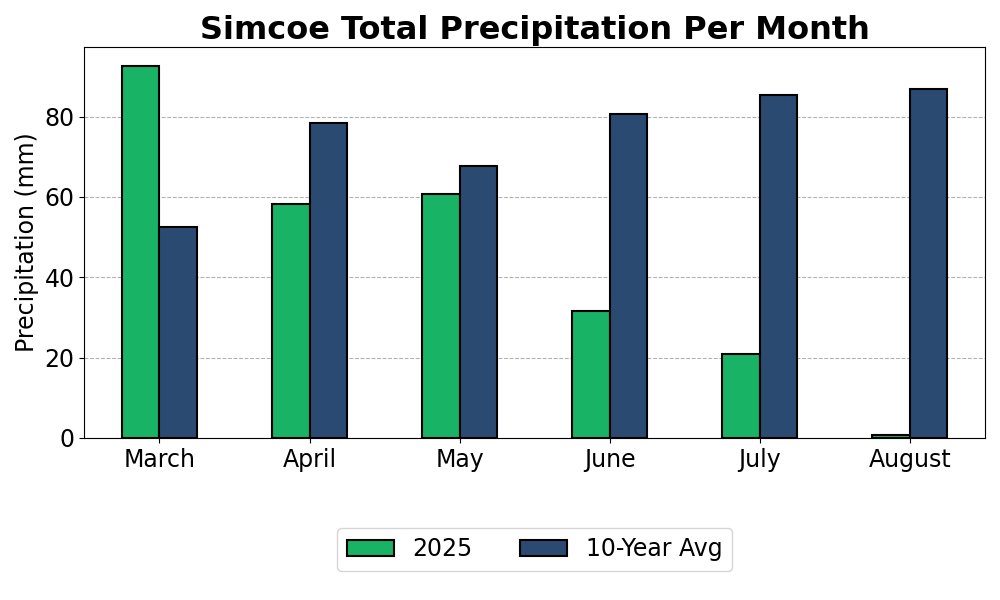
Simcoe

Sudbury


Thunder Bay


Timiskaming


Wellington Centre


Wellington North


0 comments on “VCR – Vegetable Crop Report – August 15th, 2025”