
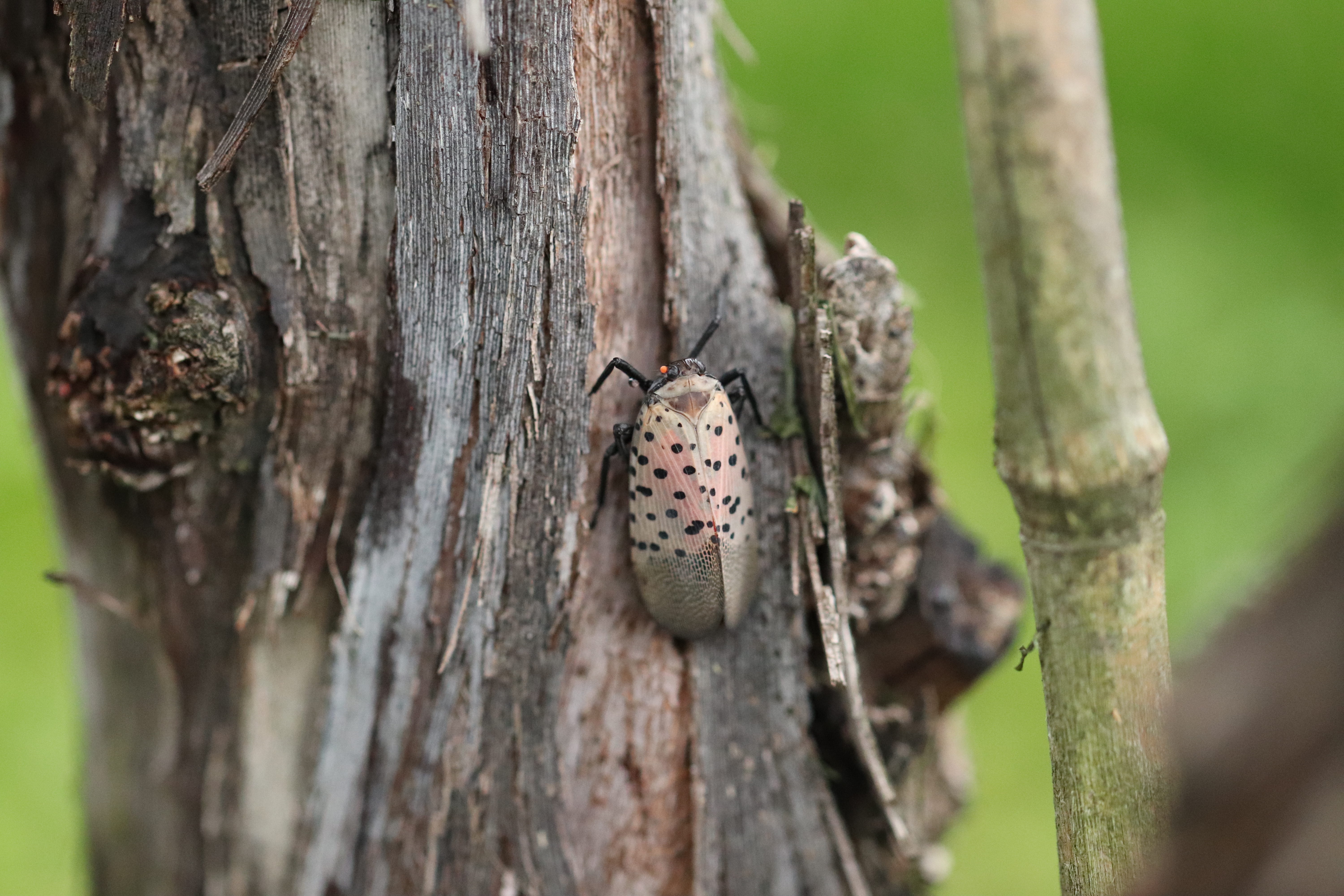
Spotted lanternfly (Lycorma delicatula, SLF) is an invasive planthopper that threatens Ontario’s agricultural sector. The pest was accidentally introduced to the United States (US) from its native range in China and has since spread to multiple states including those bordering Ontario. Due to its proximity and the numerous pathways for entry, the risk of introduction to Canada is considered very high. To help mitigate against the spread, the Canadian Food Inspection Agency (CFIA) added SLF to their list of regulated pests in 2018. For information on CFIA’s decision for managing the risk of SLF in Canada and the pest risk management options that were considered see Pest Risk Management Decision Document for Spotted Lanternfly (RMD-22-03).
Although SLF will feed on a diverse range of agricultural crops and landscape plants, grapevines are one of the few preferred season-long hosts. Prolonged feeding by adults can weaken the vine, leading to loss of winter hardiness, reduced or no return bloom or crop, and vine death. High numbers have also been correlated with a reduced yield and fruit quality the following year. But so far, grapevines appear to be the only agricultural crop that supports sustained feeding and where economic injury has been confirmed.

Adding insult to injury, SLF is a nuisance pest that can ruin the enjoyment of being in outdoor spaces. Adults can be overwhelming when they gather in large swarms during the fall flight period, affecting everyone from patrons of wineries to urban dwellers walking beneath tree-covered paths. Their heavy feeding produces honeydew, which rains down onto plants, decks, and vehicles, creating a sticky mess that develops into black sooty mould and attracts stinging insects, adding another layer of discomfort and risk for anyone working outdoors.

Nymphs are not picky eaters and will feed on just about any tender shoot (SLF doesn’t feed on fruiting structures) as they grow, and they are constantly on the move in search of things on which to dine. But as they mature and plants begin to senesce or die back, their host range narrows considerably. By late summer and early fall, adults have moved onto woody trees, shrubs, and vines. You may have read that tree fruit (apple and tender fruit), hops, and a few other crops are at risk. But so far, observations in the US indicate these are transient hosts that SLF spend very little time on before moving on to something better-suited to their voracious sap-sucking requirements (grapevines, invasive tree of heaven, maple, walnut, and a few other tree species), needed to fuel their movement, sexual maturity, and egg-laying. In addition to grapevines, heavy feeding has contributed to the death the invasive tree tree-of-heaven and black walnut saplings. Spotted lanternfly is a plant stressor and repeated attacks may contribute to the long-term weakening of established plants and trees. Research and time will help inform plant health risks to commodities other than grapevines.

Though the CFIA has not confirmed any established populations in Canada, there have been some notable sightings and interceptions (live and dead) of SLF including several in southwestern Ontario and in Niagara. CFIA categorizes observations as:
- Sighting: Reports that the CFIA is aware of, including those made on public reporting sites (for example, iNaturalist Canada, Facebook, etc.), but where CFIA followed-up on these, and could not confirm the report, as no SLF specimen was found.
- Interception: Live SLF, confirmed by the CFIA, in contained situations (e.g. warehouse) with no evidence of release to the Canadian environment; and/or dead SLF, confirmed by the CFIA.
- Detection: Live SLF, confirmed by the CFIA, in the Canadian environment
- Established population: Evidence of a reproducing population in the Canadian environment, confirmed by the CFIA.
Given the established populations across the border in Michigan, Ohio, and New York, it’s only a matter of time before SLF hitches a ride here on a vehicle or boat (if it hasn’t already). Enhanced surveillance in these and other high-risk areas is a priority of the CFIA and its partners.

The CFIA has published their directive on requirements for various articles moving from regulated (once established) to non-regulated areas in Canada to help prevent the spread. Nursery stock (woody trees, vines, and shrubs) and logs of deciduous species with bark attached have specific phytosanitary documentation requirements to allow movement out of a regulated area. But the directive also states that all things moving from a regulated area to an unregulated area must be free from all life stages of SLF prior to being moved. This catch-all statement applies to everyone, including growers, businesses, agencies, and the public. Growers and agri-businesses need to be thinking about vehicles, farm equipment, harvest bins, and anything else that gets moved off the farm. The adults are big and showy, but their egg masses are easily missed. And SLF females lay their eggs on … almost anything. Don’t be a vector by packing this pest: learn to identify SLF life stages and make sure to inspect your incoming and outgoing loads.
If you think you’ve found SLF (alive or dead), take a picture or a video, collect a sample, and report it to the CFIA.
For more information see Spotted lanternfly prevention practices for producers.
0 comments on “Spotted Lanternfly Update – See It? Stop It. Don’t Spread It.”