
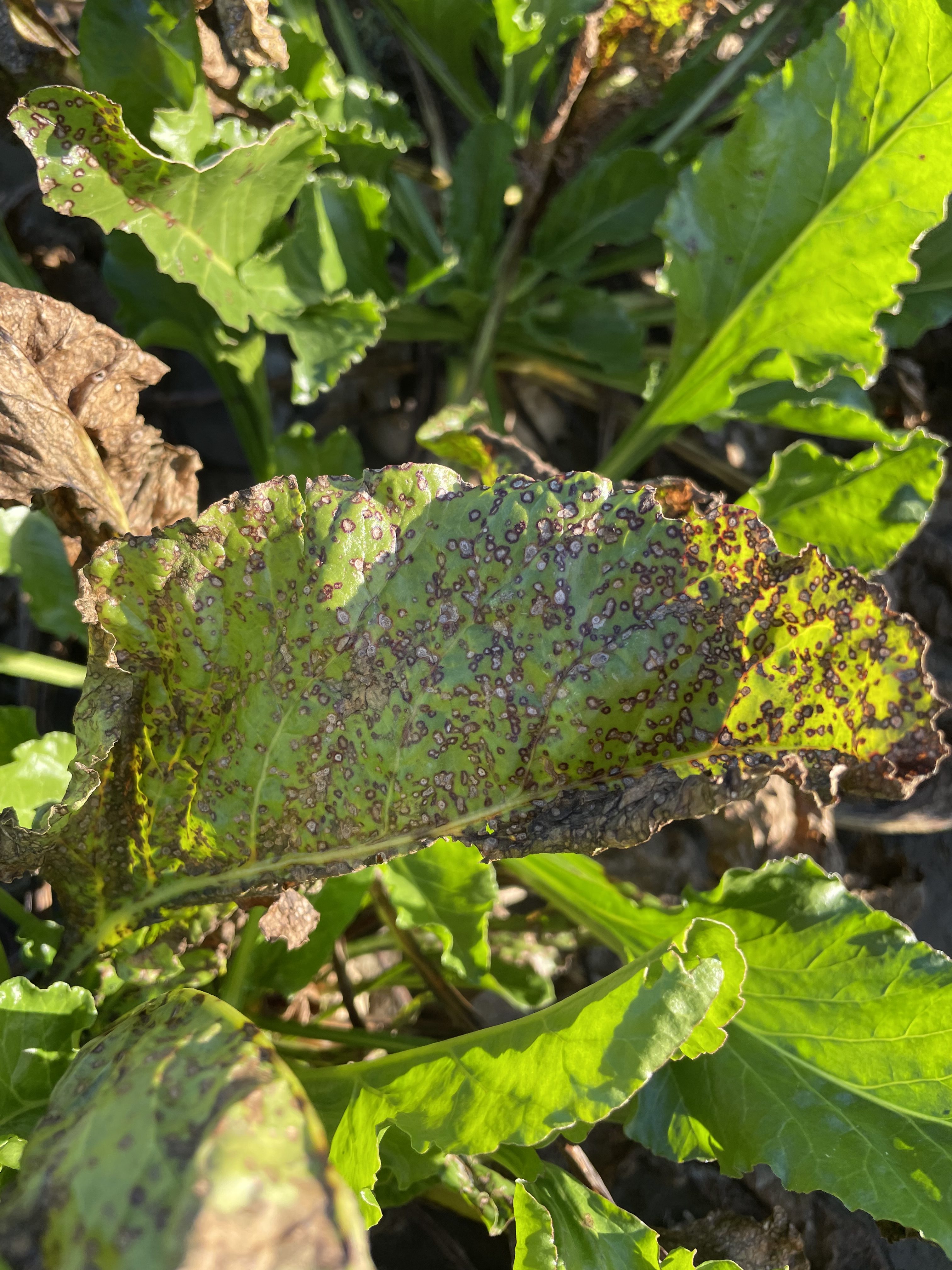
Sugarbeet growers in Kent County continue to struggle with potential resistance to group 3 fungicides in fields affected by Cercospora Leaf Spot (CLS) (Figure 1). The causal agent of CLS, the fungal pathogen Cercospora beticola, has a long history of fungicide resistance in North America, which has been narrowing the control options for the disease.

Chemical control options for CLS management available in Canada (Table 1) primarily include fungicides from the following FRAC (Fungicide Resistance Action Committee) groups:
- Group 1: Methyl benzimidazole carbamates (BMC)
- Group 3: Demethylation inhibitors (DMI)
- Group 11: Quinone outside inhibitors (QoI)
- Group M1: Copper hydroxide and copper octanoates
- Group M3: Dithiocarbamates
In Ontario, C. beticola populations have confirmed resistance to group 11 and group 1 fungicides. Therefore, farmers have mostly been relying on group 3 triazoles, such as Proline 480 SC (Bayer Crop Science). However, overreliance on triazoles is now driving resistance to group 3 products as well.
Triazole-resistant C. beticola strains have also been detected in other sugarbeet-growing regions worldwide, including Japan, Greece, Czech Republic, Serbia, and in the U.S., in Michigan, North Dakota, and Minnesota.
| Product | Active compound | Group | Resistance Risk |
| Senator 50 SC | thiophanate-methyl | FRAC 1 | High |
| Proline 480 SC | prothioconazole | FRAC 3 | Medium |
| Mettle 210 ME | tetraconazole | FRAC 3 | Medium |
| Quadris Top | difenoconazole + azoxystrobin | FRAC 3,11 | Medium, High* |
| Miravis Duo | difenoconozole + pydiflumetofen | FRAC 3,7 | Medium, Medium-High* |
| Priaxor | pyraclostrobin + fluxapyroxad | FRAC 7,11 | Medium-High, High* |
| Acapela | picoxystrobin | FRAC 11 | High |
| Headline EC | pyraclostrobin | FRAC 11 | High |
| Coppercide WP | copper hydroxide | FRAC M1 | Low |
| Kocide 2000 | copper hydroxide | FRAC M1 | Low |
| Parasol WG | copper hydroxide | FRAC M1 | Low |
| Cueva | copper octanoate | FRAC M1 | Low |
| Manzate Pro-stick | mancozeb | FRAC M3 | Low |
| Serenade OPTI | Bacillus subtilis strain QST 713 | FRAC BM2 | Unknown |
How resistance develops?
Resistance to a particular fungicide develops when a new mutation occurs in a pathogen population, allowing certain strains to survive fungicide treatments that would normally kill them. When a particular product or different products with the same mode of action is used repeatedly, these resistant strains have a better chance to thrive, as they no longer face competition from the sensitive strains that have been eliminated. Over time, resistant strains become more common, making the fungicide less effective.
Certain practices can speed up resistance development. For example, if the same fungicide is applied repeatedly within or between seasons, or if off-label rates are applied, the selective pressure on the pathogen population increases, encouraging the survival of resistant strains. Additionally, using a single fungicide group throughout the growing season without rotating to different modes of action further promotes resistance.
Resistance management for sugarbeets
While the search for alternative fungicides is ongoing, efficient methods for controlling CLS remain limited. To help slow down resistance, it is crucial to rotate or tank-mix fungicides from different FRAC groups, apply them at recommended rates, and integrate non-chemical strategies such as crop rotation and resistant varieties.
- Use sugarbeet varieties with good tolerance to Cercospora Leaf Spot.
- Do not wait until an outbreak starts to spray. Use BEETcast to determine best spray date. Generally, 50 DSV (disease severity value) is a good starting point.
- Always include either copper or mancozeb in your triazole fungicide tank-mix.
0 comments on “Fungicide Resistance in Sugarbeets”