


Welcome back to the next VCR of 2025!
Currently most counties are trending slightly above their 10 year average GDD, with Timiskaming and Sudbury trending slightly below their 10 year average.
Crop Updates
Brassica Crops – Alternaria is active and early detection and management of Alternaria will reduce potential inoculum later in the season. Incorporate all plant debris immediately after harvest to lower the amount of inoculum available to infect later plantings. With the hot and wet weather, be on the look out for Sclerotinia/white mould. The mould tends to start near the ground on plants and as it infects it creates dark, water-soaked areas on the lower leaves near the base at the soil line. As the pathogen progresses you may see white mycelial growth. These water-soaked lesions enlarge and can cause the leaves to wilt. Infected cabbage heads will retain their shape but will be filled with a soft, watery rot. If conditions are favourable for the Sclerotinia, you will see the white mycelial growth followed by small, black spots/spores that look like mouse droppings within the fluffy white growth. These black spores can overwinter in the soil for up to 8 years and the best preventative management strategy is to rotate with non-susceptible crops such as beets, onions, spinach, corn, cereals or grasses. It is also helpful to decrease the plant density of the field to allow for adequate air circulation. Allow the top inch of soil to dry out between irrigation events and incorporate residue from harvested areas as deep as possible. Continue to scout for lepidopteran pests, aphids, and thrips. Thresholds for lepidopteran pests using the cabbage looper equivalent can be found here: VCR – Vegetable Crop Report – June 12th, 2025 – ONvegetables
Cucumbers – with active infections reported in Michigan and unconfirmed reports in Ontario, it is safe to say that the downy mildew season has begun. The Hausbeck lab at MSU posts regular updates on their downy mildew spore trapping program at https://veggies.msu.edu/downy-mildew-news/ To date they have found an airborne presence for P. cubensis clade 2 which infects cucumbers and cantaloupe. Refer to Friday’s article for specific downy mildew recommendation in cucumbers. Downy Mildew Confirmed in Michigan – June 25, 2025 – ONvegetables
Garlic – Harvest is one to two weeks away and some fields are quickly senescing if they are overly stressed. For the best yield and storability, allow the crop to reach at least 40% yellowing/senesce before harvesting. Depending on how quickly your soil dries out, avoid irrigating too close to harvest as soil stuck to the bulb will make it more difficult to achieve a clean wrapper. If black plastic has been used for weed control, cutting it open to allow the soil to dry before harvest can also help with wrapper cleaning. If leek moth counts were high last week, consider targeting the larvae that are now feeding on the crop. If mites or Fusarium were issues in storage last year, refer to this article with information about curing: https://onvegetables.com/2021/12/09/stored-garlic-might-have-mites/
Onions – The threshold for the second generation of onion maggot has been reached in southern most part of the province in the past week so be on the lookout for second generation onion maggot damage. Lower amounts of new cutworm damage this week. Stemphylium has been observed in multiple fields across the province. If Penflufen was part of the seed treatment, do not start with a foliar group 7 fungicide. For the first application, a product containing mancozeb (group M3s, such as Manzate Pro-Stick, Dithane Rainshield, and Penncozeb 75 DF Raincoat) may provide protection against Stemphylium if it is being applied to manage onion smut, Botrytis or Alternaria/Purple Blotch. the second foliar product, Allegro 500F (group 29) or products containing a group 7 show the best efficacy, such as Sercadis, Aprovia, or Miravis Duo (group 7/3). Research has shown that there is very high resistance in Stemphylium to one of the fungicides in Quadris Top (group 11/3) and in Luna Tranquility (group 7/9). Avoid applying products registered for onion Stemphlium with the same chemical group one after the other to reduce the selection pressure and reduce the chance of resistance. Stemphylium may become resistant to group 7 or group 29 fungicides if they are not rotated with other FRAC groups. The level of thrips are likely to reaching threshold in many. Past research has shown that Movento 240 SC (group 23) has some residual activity that works better against larvae when it is applied earlier in the season as the first insecticide. Once the threshold of thrips/leaf has been reached, Movento 240 SC (two applications) could be followed by two applications of Agri-Mek (group 6) or Delegate (group 5). Entrust (group 5), Success (group 5), and Exirel (group 28) are also registered for thrips on onions. Using a penetrating surfactant can be useful to maximize the effectiveness of products against thrips. Apply no more than two consecutive insecticides from the same IRAC crop as thrips have a relatively short life cycle with multiple generations through the summer months and are at a high risk of developing insecticide resistance.
Sweet corn – as the plants begin silking they are at risk of becoming infested with corn earworm. According to www.insectforecast.com there has been low risk of flight into the great lakes region this spring. However, it is very hard to predict the movement of this pest and there have been several risky weather patterns over the past 10 days. Protective insecticide sprays during the silking period will help to control larvae as they hatch and before the enter the cob.
Pest Degree Day Forecasting
| County | Carrot Rust Fly | Onion Maggot | Carrot Weevil | Aster Leafhopper | Tarnished Plant Bug | Cabbage Maggot | Seedcorn Maggot | European Corn Borer |
| THRESHOLD | 329-395, 1399-1711 | 210-700, 1025-1515 | 138-156, 455+ | 128+ | 40+ | 314-398, 847-960, 1446-1604 | 200-350, 600-750, 1000-1150 | See legend below |
| Bruce*** | 839 | 750 | 510 | 380 | 223 | 584 | 750 | 324 |
| Chatham-Kent* | 1098 | 995 | 711 | 554 | 358 | 798 | 995 | 483 |
| Durham*** | 946 | 855 | 610 | 463 | 289 | 688 | 855 | 399 |
| Essex* | 1188 | 1083 | 792 | 624 | 408 | 884 | 1083 | 547 |
| Huron*** | 950 | 854 | 603 | 464 | 297 | 680 | 854 | 405 |
| Kemptville*** | 986 | 896 | 644 | 498 | 324 | 724 | 896 | 436 |
| Lambton** | 1051 | 948 | 674 | 521 | 338 | 760 | 948 | 455 |
| Middlesex** | 1077 | 978 | 704 | 544 | 353 | 790 | 978 | 475 |
| Norfolk** | 1028 | 929 | 653 | 499 | 320 | 740 | 929 | 433 |
| Peterborough | 920 | 828 | 577 | 437 | 268 | 656 | 828 | 376 |
| Renfrew | 919 | 833 | 592 | 456 | 294 | 669 | 833 | 396 |
| Simcoe*** | 919 | 827 | 584 | 445 | 283 | 660 | 827 | 386 |
| Sudbury*** | 727 | 654 | 453 | 343 | 207 | 516 | 654 | 296 |
| Thunder Bay | 591 | 524 | 345 | 243 | 121 | 400 | 524 | 198 |
| Timiskaming*** | 696 | 625 | 438 | 335 | 203 | 495 | 625 | 287 |
| Wellington Centre** | 922 | 829 | 579 | 439 | 274 | 659 | 829 | 379 |
| Wellington North** | 925 | 835 | 583 | 451 | 285 | 662 | 835 | 393 |
*- Bivoltine region for ECB. First Peak Catch: 300-350 DD, Second Peak Catch 1050-1100 DD
**- Overlap region for ECB. First Peak Catch: 300-350 DD Second Peak Catch 650-700 DD, Third Peak Catch 1050-1100 DD
***-Univoltine region for ECB. Peak Catch 650-700 DD
Use these thresholds as a guide, always confirm insect activity with actual field scouting and trap counts
Select a region below for the latest weather, crop and pest degree day information:
Bruce


Chatham-Kent


Durham


Essex


Huron


Kemptville


Lambton


Middlesex


Norfolk


Peterborough


Renfrew


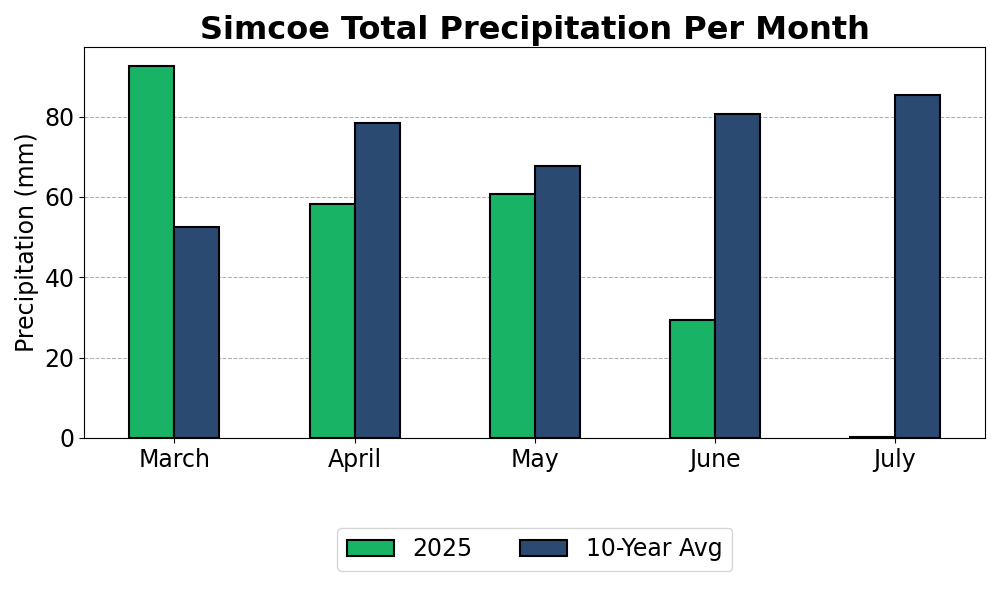
Simcoe

Sudbury


Thunder Bay


Timiskaming


Wellington Centre


Wellington North


0 comments on “VCR – Vegetable Crop Report – July 3rd, 2025”