


Welcome back to the next VCR of 2025!
Currently most counties are trending close to their 10 year average GDD, with Bruce county trending slightly above their 10 year average.
Crop Updates
Brassica Crops – Rapid growth due to heat and excess moisture may lead to nutrient deficiencies, tip burn and hollow stem in broccoli over the next couple of weeks. These abiotic disorders often vary by cultivar in their severity. Alternaria is active and early detection and management of Alternaria will reduce potential inoculum later in the season. Incorporate all left-over plant tissue immediately after harvest to lower the amount of inoculum available to infect later plantings. Avoid increasing the leaf wetness period of the crop by irrigating only in the morning when plants are already moist due to the morning dew.
Carrots – Carrots are growing well but getting stressed with the recent heat and dry conditions in some regions. Threshold for carrot weevil adults to lay eggs has passed. Monitor your field for carrot rust fly and Aster leafhoppers. Aster leafhopper infectivity numbers from Michigan this year have been relatively high so treat based on local field scouting counts.
Garlic –Allow the crop to reach at least 40% yellowing/senesce before harvesting for better yields and increased storability. The ideal time for optimum yields is to harvest porcelain cultivars (such as Music) when 50% of the leaves have senesced or turned yellow. Since it takes several days to harvest, many growers start at 40% and by the time the crop is fully harvested it may have reached 70%. Always avoid leaving harvested bulbs in direct sunlight after they have been pulled. Focus on curing the crop quickly if Fusarium or mites have been a problem in the past: https://onvegetables.com/2021/12/09/stored-garlic-might-have-mites/
Onions – Many direct seeded fields are at the 6-7 leaf stage. The levels of thrips are starting to rise. Play close attention to fields bordering hay and wheat as the levels of thrips will generally start to increase as hay is cut and wheat is harvested. Apply no more two applications of the same insecticide targeting thrips for resistance management. Stemphylium is starting to colonize the yellow leaf tips in many fields across the province. If Penflufen was part of the seed treatment, do not start a foliar fungicide program with a group 7 fungicide. For the first application to manage Stemphylium, a product containing mancozeb (group M3s, such as Manzate Pro-Stick, Dithane Rainshield, and Penncozeb 75 DF Raincoat) may provide protection against Stemphylium if it is being applied to manage onion smut, Botrytis or Alternaria/Purple Blotch. Avoid applying products from the same chemical group one after the other to manage Stemphylium. For the second foliar product, Allegro 500F (group 29) or products containing a group 7 show the best efficacy, such as Sercadis, Aprovia, or Miravis Duo (group 7/3). Research has shown that there is very high resistance in Stemphylium to one of the fungicides in Quadris Top (group 11/3) and in Luna Tranquility (group 7/9). Avoid applying products from the same chemical group one after the other to reduce the selection pressure against group 7 or group 29 fungicides so that they can be used to manage Stemphylium for future years.
Peppers – Bacterial spot is always a concern for pepper growers and could start showing up soon. Other disease concerns are phytophthora and fusarium, which can cause pockets of wilting plants, and crown and root rot in peppers. Using drip in stead of overhead irrigation can help to minimize the spread of all of these diseases in fields.
Potatoes – Crop is progressing well with full canopies and many fields in flower. Although we’ve had a stretch of warm weather, irrigation and regular thunderstorms mean the risk of late blight remains high. Refer to the late blight update for some management notes.
Early blight has started to show up in some fields, mostly on stressed plants.
Colorado potato beetle eggs are hatching and all stages of larvae are currently being found. Refer to the crop protection hub for a list of registered products.
Time foliar applications to target smaller larvae. Don’t follow-up with a group 4 insecticide if you used one at planting. Rotate chemistries after each application.
Other potato pests have also been seen including potato leaf hopper adults and tarnished plant bugs.
Most of the at-plant insecticide will have worn off by now so treat on a threshold basis based on scouting numbers.
Tomatoes – Tomato crops are progressing nicely, though there are a number of disease concerns coming up right now. Most importantly, late blight (Figure 1) which has shown up in July for the past couple of years.

Though symptoms have not yet been reported, late blight spores have been caught in spore traps in Essex, Kent, Elgin, and Norfolk counties. Growers should be vigilant and keep an eye out for the first signs of late blight on foliage. This is a community disease and if you see late blight in your field, please notify OMAFA staff. If late blight is found in your field or a neighbouring field, fungicides with specific late blight activity should be added to your fungicide program to prevent significant crop losses. Always be sure to read every product label carefully before each application.
Other disease concerns are phytophthora and fusarium, which have been causing pockets of wilting plants, and crown and root rot in many fields. Bacterial spot has also made its way into Ontario and is being seen in tomato fields. Using drip instead of overhead irrigation can help to minimize the spread of the disease within fields. Another pest to scout for at this time of year is stink bug. Stink bugs are thought to migrate into tomatoes as wheat is harvested. Look for adults (Figure 2) and nymphs (Figure 3) that like to hide deep in the plant canopy. Another way to scout for stink bugs is to look for the damage they cause like dimples (Figure 4) and light-coloured, snowflake patterns (Figure 5) on the fruit. Once stink bugs are found in your crop, you should follow a weekly spray program to keep numbers as low as possible. This is a very difficult pest to scout for and control. If you think you have a stink bug problem, please reach out to amanda.tracey@ontario.ca for information and guidance.


Pest Degree Day Forecasting
| County | Carrot Rust Fly | Onion Maggot | Carrot Weevil | Aster Leafhopper | Tarnished Plant Bug | Cabbage Maggot | Seedcorn Maggot | European Corn Borer |
| THRESHOLD | 329-395, 1399-1711 | 210-700, 1025-1515 | 138-156, 455+ | 128+ | 40+ | 314-398, 847-960, 1446-1604 | 200-350, 600-750, 1000-1150 | See legend below |
| Bruce*** | 952 | 856 | 596 | 451 | 274 | 677 | 856 | 388 |
| Chatham-Kent* | 1237 | 1127 | 822 | 651 | 433 | 916 | 1127 | 572 |
| Durham*** | 1078 | 980 | 714 | 553 | 357 | 799 | 980 | 482 |
| Essex* | 1333 | 1221 | 909 | 727 | 490 | 1008 | 1221 | 644 |
| Huron*** | 1077 | 974 | 701 | 549 | 361 | 786 | 974 | 483 |
| Kemptville*** | 1113 | 1016 | 743 | 583 | 388 | 830 | 1016 | 514 |
| Lambton** | 1188 | 1079 | 783 | 617 | 412 | 877 | 1079 | 543 |
| Middlesex** | 1210 | 1104 | 808 | 635 | 423 | 902 | 1104 | 559 |
| Norfolk** | 1157 | 1050 | 754 | 586 | 386 | 847 | 1050 | 512 |
| Peterborough | 1010 | 913 | 647 | 497 | 313 | 731 | 913 | 431 |
| Renfrew | 1093 | 998 | 730 | 576 | 386 | 816 | 998 | 507 |
| Simcoe*** | 1048 | 949 | 685 | 531 | 349 | 768 | 949 | 466 |
| Sudbury*** | 820 | 741 | 522 | 400 | 246 | 591 | 741 | 347 |
| Thunder Bay | 686 | 612 | 412 | 296 | 153 | 474 | 612 | 243 |
| Timiskaming*** | 801 | 723 | 515 | 398 | 245 | 580 | 723 | 343 |
| Wellington Centre** | 1045 | 945 | 674 | 520 | 334 | 761 | 945 | 453 |
| Wellington North** | 1047 | 950 | 677 | 531 | 344 | 763 | 950 | 466 |
*- Bivoltine region for ECB. First Peak Catch: 300-350 DD, Second Peak Catch 1050-1100 DD
**- Overlap region for ECB. First Peak Catch: 300-350 DD Second Peak Catch 650-700 DD, Third Peak Catch 1050-1100 DD
***-Univoltine region for ECB. Peak Catch 650-700 DD
Use these thresholds as a guide, always confirm insect activity with actual field scouting and trap counts
Select a region below for the latest weather, crop and pest degree day information:
Bruce


Chatham-Kent


Durham


Essex


Huron


Kemptville


Lambton


Middlesex


Norfolk


Peterborough


Renfrew


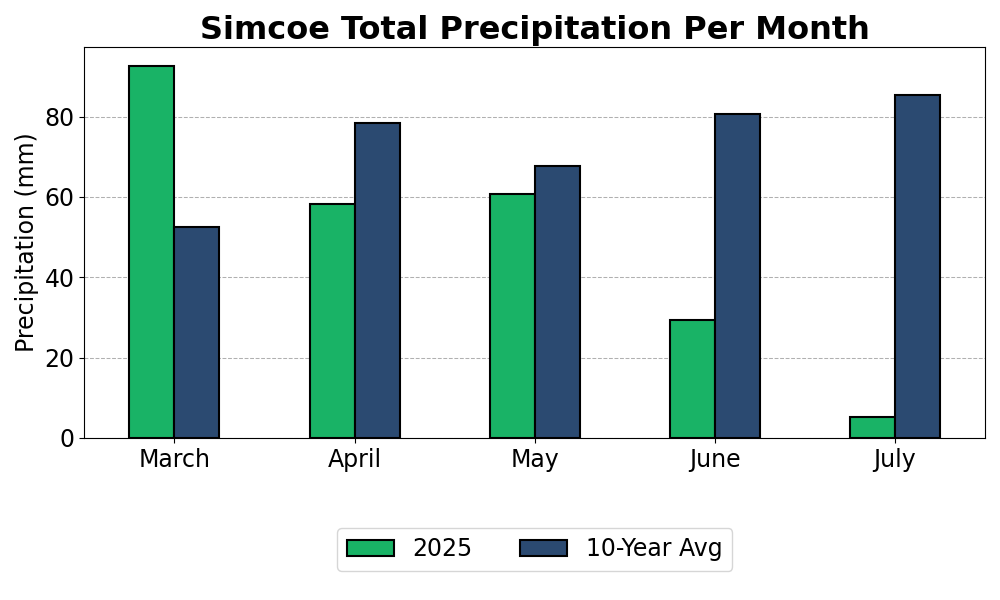
Simcoe

Sudbury


Thunder Bay


Timiskaming


Wellington Centre


Wellington North


0 comments on “VCR – Vegetable Crop Report – July 10th, 2025”