
What is clean seed production?
Garlic is a vegetatively grown crop, similar to potatoes or strawberries, that multiplies not by seed, but asexually by cloves. Unlike true seed production, plants that reproduce asexually accumulate viruses and other pathogens in each progressive generation that often results in a drag in yield. By propagating material that has been indexed for specifically commercially significant viruses through tissue culture, growers are able to take advantage of that boost in yield until viruses and other pathogens build up again in the crop.
Virus infection is generally transmitted by sap-sucking insects like aphids, thrips or leafhoppers, but it can also spread through pruning or mechanical injury. Insects that transfer viruses generally have a stylet that pierces the plant’s cells and if a virus is present within the cell, the virus can enter the insect’s foregut and salivary glands as the insect feeds from the plants. When the insect moves to a new plant and pierces it, some virus-infected saliva may be left behind from the previously visited plant thereby transferring the virus to the new plant. Viruses can accumulate in plants over years of production while not causing any visible symptoms. These viruses slow the plant down by causing a yield drag or making the plant more susceptible to other stressors.
Some crops, like potatoes, have a certified seed program which is federally regulated and has set limits on how much disease and virus can be tolerated. There are also seed classes based on generation and disease/virus levels. Other smaller crops, such as garlic, do not have the same regulations, so seed is often reused indefinitely. In garlic, there is the option of growing out bulbils, the seed-like structure that is found in the scape in hardneck varieties. Growing the bulbils can clean the seed of nematodes, bulb mites, fungi and bacteria, but viruses are still found in this part of the plant.
Viruses can not be cured with a pesticide application. For some crops, meristem tissue culture is used to propagate plants since this rapidly dividing area of the plant is generally free of viruses. This tip is removed and placed in media with the appropriate nutrients and these tips can grow into plants that no longer have the load of viruses that the original plant had.
How New Liskeard became the home to producing clean plant material
In 1983, the SPUD Unit at the New Liskeard Agricultural Research Station (NLARS), University of Guelph was established to service the seed potato industry with clean potato planting stock (Figure 1). Over the decades, the research facility has expanded its portfolio of crops outside of potatoes and has conducted research on many crops including strawberries, raspberries, cucurbits, hazelnuts, tomatoes, sweet corn, cauliflower, cabbage, broccoli, green beans and garlic.

What is particularly unique about the SPUD Unit research facility at NLARS is where it is located. This latitude still experiences enough heat units for field trials, yet it is typically sheltered from the effects of the jet-stream throughout most of the growing season. This is important, as the jet-stream has been known to carry virus-transmitting insects such as aphids. This allows for the amplification of clean stock with a lower risk of virus infection.
How garlic is produced by the Clean Seed Program
The SPUD Unit first worked on a Clean Seed Program (CSP) for garlic in the 2000s, when a project to develop clean seed was undertaken by NLARS, California Garlic and Onion Research Advisory Board, Federal Economic Development Agency for Northern Ontario (FedNor), as well as the Garlic Growers Association of Ontario (GGAO). The research project found environmental conditions to store virus-indexed planting stock of the garlic cultivar ‘Music’ in tissue culture. The garlic scape was chosen as the meristem to enter the tissue culture program since the cells at the tip of the scape grow faster than the viruses can infect them. These tiny tips are cut and on media in a test tube. Under lights and ideal growing temperatures, these tips grow and produce small plantlets. Once the plantlet is large enough, tips of its leaves are placed in new test tubes to determine if there is bacterial or fungal contamination. Once the plant is thought to be free of larger pathogens, it is sent to be indexed against certain garlic viruses. From there, plantlets are micro propagated to build up numbers and eventually transplanted into potting soil in trays within the greenhouse for these small plants to produce single bulbs known as roundels (Figure 2).

Once the roundel is harvested, they are sent to growers who plant them in the field or greenhouse to multiply and bulk up as quickly as possible. The roundels leave the SPUD unit about half the size of a dime or larger than 7.5 mm in diameter. If planted in ideal growing conditions, the roundel produces a small bulb after the first growing season. These small bulbs are separated into cloves that are planted the following year to produce bulbs of an average size. It is often in the third year where a large increase in size and yield is typically seen (Figure 3).

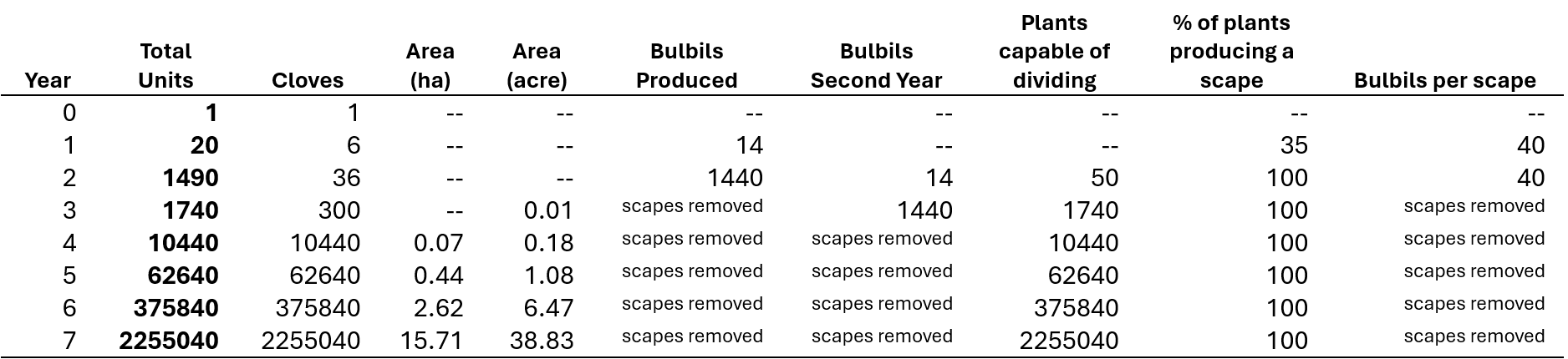
How quickly can garlic planting stock from the clean seed program be propagated? A single roundel can produce 280,000 plants after seven generations if scapes are removed and no bulbils are harvested from the clean plants. If the bulbils are saved and harvested from the clean plants in the first two years, those bulbils could be planted as clean seed planting stock as well. If bulbils are collected the first two years, a single roundel can produce 2.2 million cloves after 7 generations, enough to plant 15 ha (38 acres) in the 8th year of production if 143 k cloves are required for planting one hectare (~58 k plants / per acre) (Table 1). If growers continually choose to use clean seed planting stock, over time the virus load will be pushed out of the production system. While planting stock from the clean seed program may cost more, the benefits and increases in yield outweigh these initial costs.
Table 1. A single roundel producing ~2.2 million cloves after seven generations if bulbils are collected from scapes during the first two years of production.
Other countries, including Spain, produce clean garlic planting stock as well, but the cultivars that grow well in Spain do not always perform well in Canadian conditions. Importing planting stock from other counties is often difficult to implement in time for planting. Currently, the SPUD Unit offers the most local source of planting material that has been tested in our climate and growing conditions.
Comparing clean seed to conventional planting stock
In 2020, additional garlic cultivars were added to the garlic germplasm at the SPUD Unit, as a part of a Special Initiatives research grant UG-SI-2020-100748. The new cultivars included Guelph, Polish White, Portugal 1 Azoles, Red Russian Marbled Purple Stripe (MPS) and Ukraine. These plants were indexed for viruses, micro-propagated and roundels were available for planting in a research trial in 2022 (Figure 2, above). These roundels produced small bulbs in 2023 and were planted in Dashwood and Grand Bend to produce average size bulbs in 2024. In the fall of 2024, garlic cloves from the clean seed program were planted alongside cloves of a similar size of their conventional counterparts in soils in which both clean and conventional cloves were planted in the previous year. In addition to the Grand Bend and Dashwood field sites, a third field site was added in Arthur using planting stock from the Grand Bend field site the previous year (Figure 4).

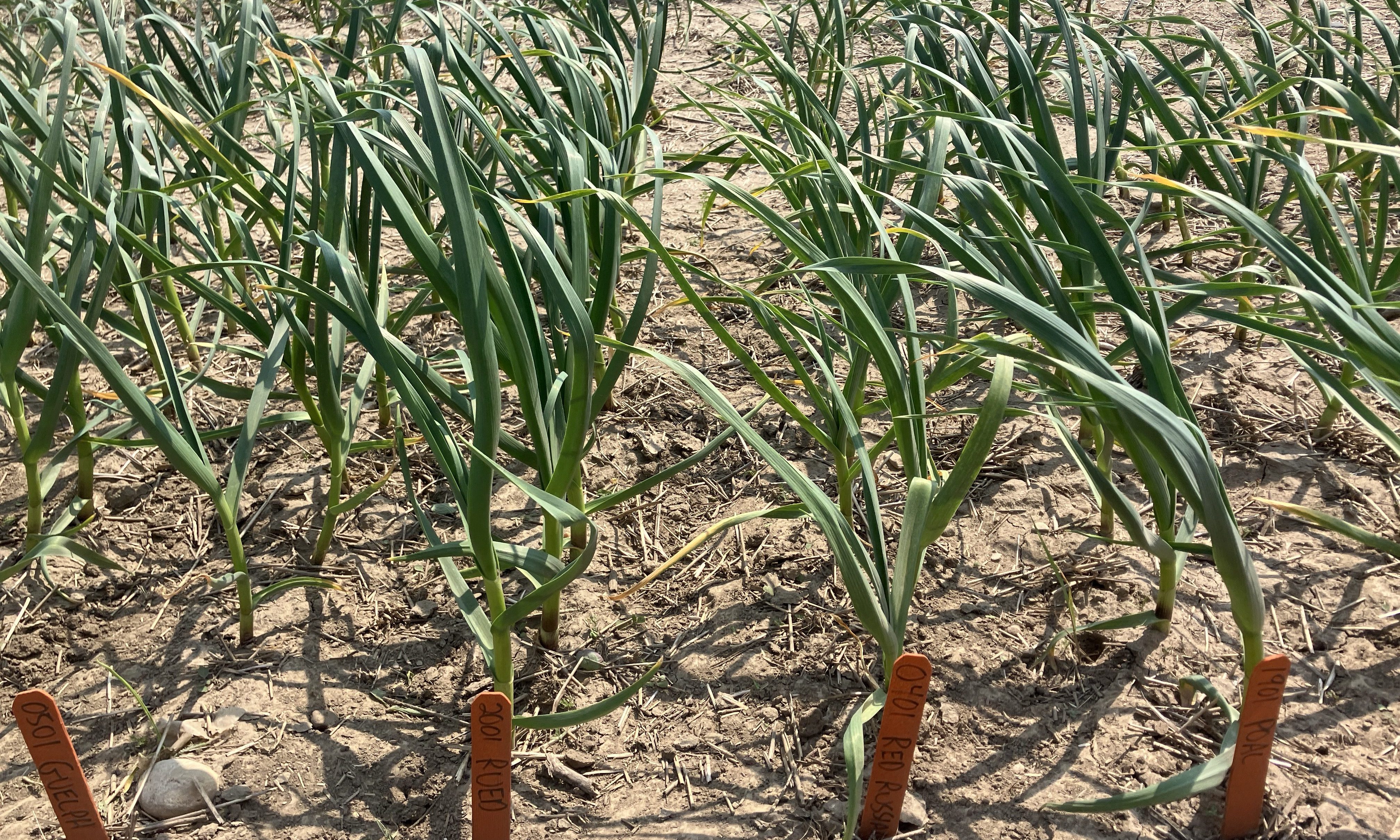
In the first week of June in 2025, yellow tips and tip dieback became noticeable on the tips of the conventional plants at the Dashwood and Arthur sites (Figure 5). Tip dieback assessments were taken in Arthur and at this site the conventional lines showed an average tip dieback of 15.4 % while the lines from the Clean Seed Program showed only a 1.5 % leaf dieback (Figure 6). Tip dieback prior to harvest was more pronounced in the conventional lines in Dashwood and Arthur than the CSP lines, but no major differences were observed in Grand Bend and data was not collected.


How much more does clean seed yield relative to conventional planting stock?
At all three locations in 2025, the lines from the clean seed program outperformed their conventional counterparts (Figure 7). The lines from the clean seed program were 31% larger than the conventional counterparts in Grand Bend, 25% larger in Dashwood and 65% larger in Arthur.

At the Arthur location, plants were not grown in the same soil type the year prior to the comparison (2023–2024) as they were in the other two field locations. All cloves planted in Arthur in 2024 were cracked from bulbs grown in Grand Bend from 2023–2024. It is interesting that the clean plants performed much better than the conventional plants in Arthur (65% increase) relative to Grand Bend (25% increase). From previous cultivar trials, it has been noted that some cultivars are more adapted for certain soil types. Guelph had the highest increase in yield (101%) compared to the conventional line and Ukraine had the lowest increase (19%). With an average increase of 61% in weight at the Arthur site when averaging all five lines, it appears that the lines from the CSP had more of an advantage than their conventional counterparts in Arthur compared to Grand Bend, even though the previous year’s planting stocks were identical. The Arthur location was planted two weeks later (Arthur was planted 22 October 2024 and Grand Bend was planted 8 October 2024) but all other factors such as storage conditions prior to planting and time between cracking and planting were similar. The CSP lines may have an easier time adapting to new soil types or may be better at getting established before winter than their conventional counterparts. While the precipitation and soil moisture levels were not recorded at either field site, the Arthur location may have experienced dryer conditions compared to Grand Bend in June/July 2025. These dryer conditions led to more plant stress, greater tip dieback, and lower yields in the conventional plants compared to the CSP lines.
The benefits of clean seed
Clean plant material offers more than just increased yield and larger bulb size. It results in more food produced on less land, fewer imports from other countries, and a greater resilience in our domestic food supply. Improved plant health with stronger plants often allows these plants to handle abiotic stresses (like drought) better, and have comparable yields compared to conventional crops with irrigation. In 2025, non-irrigated CSP plants had comparable weights to conventional planting stock plants that were drip irrigated in an adjacent field. This can be a dramatic benefit, especially in areas that do not have access to irrigation. Stronger plants with fewer viruses and other pathogens may also result in fewer pest control products (pesticides) being applied every year. Finally, improved quality at harvest means that the crop has the potential to store for longer periods of time giving Canadian growers the ability to sell a local product in months that most retailers are relying on imports from other countries.
Results from this long-term trial show that an average of a 25% increase in yield should be expected as a minimum if planting a similar size clove of clean seed compared to a conventionally grown clove. Growers that implemented clean seed in 2010 have noted vigorous plants a decade later, but how long the clean planting stock retains this yield advantage will likely vary depending on the growing conditions, production practices and the amount of viruses being vectored by insects.
Currently Ontario garlic growers who are a member of the Garlic Grower Association of Ontario (GGAO) can order roundels through their clean seed program in the fall. With limited space in the facility, the number of roundels that are currently available each year is low despite the demand.
A full summary of the report can be downloaded here:
Well done, Travis and team! The yield differences are dramatic. I hope the clean seed program will be extended to other garlic varieties.
Both an incredible Clean Seed Program and an impressive and convincing result set from trials.
Would be interesting to tracking the number of seasons until a notable decline was evident in yield from clean seed progeny succumbing to field virus infections and other seed-borne diseases, that would provide a baseline for when to introduce new clean seed.
Can I ask if the visual tip dieback noted in your published results and web page on conventional plants were disease and virus tested? It seems you were using this as an indicator of virus presence, but there did not appear to be any testing and confirmation of the causal pathogens.
Excerpt: Visual tip dieback assessments were recorded 4 June 2025 at the Arthur location due to stark differences observed between the conventional and CSP lines. Tip dieback was estimated by the percentage of yellowing on every leaf of the plant.
Hi Letetia,
The trial is moving forward only at one location for the 2025-2026 season, and the goal is to try to see if we can observe a decline in yield over time in the clean seed lines.
Great comment regarding the visual tip dieback assessments. The visual tip dieback assessments were noted as a way to observe plant stress or stunting, not necessarily the presence or absence of viruses.
Travis
I’m keen to see your results clean seed field decline over seasons.
Thanks for explaination of tip dieback. The absence of tip dieback in clean seed lines planted in same location as conventional, means nutrition and environmental causal factors can be ruled out. I think we all too often look a minor tip dieback as resulting from wind or water damage or nutrient imbalances – but when it is consistently present in conventional plants and absent in same sized clean seed progeny – it is hard to ignore the correlation of leaf tip dieback to disease causes.
Thank you again.