
Allium leafminer (Phytomyza gymnostoma) has been confirmed in Ontario as of November 21, 2025. Allium leafminer (ALM), is an invasive pest originally from Europe and has spread to several US states including Pennsylvania (2015), New Jersey (2016), New York (2017), Maryland (2017), Delaware (2019), Massachusetts (2019), Connecticut (2020), Virginia (2021) and North Carolina (2023). The US has de-regulated ALM at the national level, but California, Idaho, Oregon, and Texas regulate it under the Federally Recognized State Managed Phytosanitary Program (FRSMP). ALM can not be eradicated once it is established due to the inability to contain and the presence of wild alternative hosts, like wild leeks or ornamental Alliums, serve as reservoirs.
Background & Identification
Allium leafminer larvae can cause damage to any Allium crop, however it poses the biggest threat to leeks and chives. In the northeastern United States, ALM has been found to have two generations per year, with activity in the early spring, a summer aestivation or period of inactivity and then laying of eggs and feeding happening again in the fall. With these two periods of activity, the first period of activity mainly targets chives, overwintering garlic and transplanted leeks while the second period of activity mainly targets leeks and chives. (Figures 1-2).


Larvae cause damage by mining into the stalks, and / or bulbs of leeks, onions (dry bulb, green), garlic, shallots and chives and making affected parts of the crop unmarketable. Feeding on young plants results in distorted or twisted leaves, stunted growth, and wilting. Wounds created by the larvae are easy entry points for pathogenic fungi or bacteria. Very high rates of injury, including up to 100% crop loss, have been reported, mainly in leeks.
The larvae that mine the stalks are cream to yellow in colour, up to 8 mm (1/3 in.) in length, legless and lack a distinct head capsule (Figure 3A). They have two elongated lobes or projections at one end, which can help to distinguish them from seedcorn maggot larvae that tend to be found at the base of the plant, unlike ALM which is generally found in upper parts of the plant. ALM larvae are easily distinguished from leek moth larvae which have legs, a defined head, and are yellow to greenish in color, with small spots on each abdominal section (Figure 3B). There are often many ALM larvae on one plant versus leek moth where there are generally fewer than five.

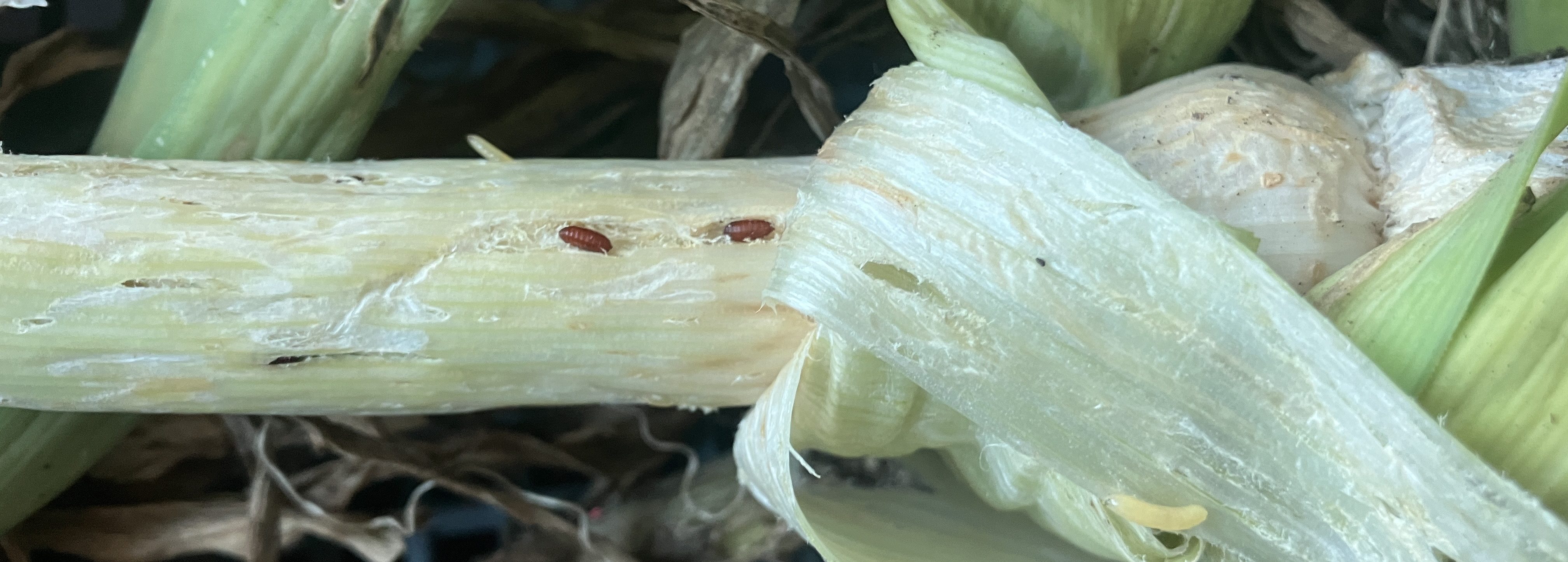
Pupae are reddish brown, 4mm long (~1/8 in.) and are found between the leaf sheaths in the same areas of the plant where the larvae feed (Figure 4). Plants that are wilted due to ALM can be pulled apart to reveal pupae and larvae feeding within the plant. The pest overwinters as pupae that remain in plant tissue, crop residue, or in the adjacent soil.

Adult ALM flies are small, around 3mm-long (1/8 in.) with a grey and black body and a yellow head (Figure 5). Females create small punctures in the Allium leaf when they are laying eggs, and both males and females feed on the plant exudates that seep out from these wounds. These punctures (oviposition activity) leave spots that resemble thrips injury, but they are larger and generally follow a distinct line (Figure 6).


Actionable Steps if Found
The ALM has been placed on the list of regulated pests by the Canadian Food Inspection Agency, which has implications to the movement of affected host plant material from infested areas. If you are in Ontario, and find what appears to be Allium leafminer damage, please report it to the CFIA by E-mailing cfia.surveillance-surveillance.acia@inspection.gc.ca, filling out this online form or by calling your local CFIA office listed below.
CFIA Plant Health Offices – Hours of operation: 8:00 am to 4:00 pm.
| Barrie: 705-739-0008 | North Bay: 705-495-5995 |
| Belleville: 613-969-4131 | Ottawa: 613-773-8660 |
| Brantford: 519-753-3478 | St. Catharines: 905-937-7434 |
| Guelph: 226-217-1200 | Thunder Bay: 807-683-4370 |
| Hamilton: 905-572-2201 | Toronto: 647-790-1100 |
| Kingsville: 519-733-5013 | Walkerton: 519-881-2431 |
| London: 519-691-1300 |
The best method of scouting for ALM is looking for oviposition marks beginning in early April on chives or garlic and looking for oviposition marks or wilting on fall leeks (Figure 6). Plants are considered heavily infested when there are more than 20 larvae / pupae on a single plant (Ng, et. al., 2025).
Once found, different management strategies will vary in effectiveness. A breakdown of effectiveness for each management strategy is listed below:
Management Options
Exclusion Net / Floating Row Cover – Estimated Effectiveness – Very High
Use an exclusion net or floating row cover with a very fine mesh (such as ProtecNet 25g) and use hoops so that the net is not resting on the plants – insects can land on the netting and sometimes lay eggs through the netting). The netting must be installed before flies emerge which is typically the third week of March for the first generation or early September for the second generation. Practice crop rotation and avoid planting any Allium in areas where ALM pupae may be overwintering from last year’s crop as the exclusion net or floating row cover will contain them with this year’s crop.
Crop Destruct – Estimated Effectiveness – High
Rogue out / remove infested plants and destroy pupae and larvae by deeply burying plants or some other method of destruction such as burning.
Conventional Insecticides – Estimated Effectiveness – High
Some insecticides show efficacy against ALM. Exirel (group 28) was proactively pursued by Ontario as a minor use submission and was registered specifically for Allium leafminer on bulb vegetables (including chives, garlic, leek, onion & shallots) as of October 2022. Insecticides registered for management of thrips such as Agri-Mek (group 6) and Delegate (group 5) may also have some activity on ALM but are not specifically registered for ALM. Check the Ontario Crop Protection Hub for a full list of registered insecticides depending on what Allium you are growing (Chives, Garlic, Leeks, Onion, Shallots)
Organic Insecticides – Estimated Effectiveness – Medium
Some organic insecticides, such as Entrust (group 5), that is currently registered for suppression of thrips and leek moth on chives, garlic, leeks, onions and shallots, may offer some protection against ALM but is currently not specifically registered for ALM.
Production Timing – Estimated Effectiveness – Medium
Delay planting or harvest early to avoid the fall larva damage period in leeks. If growing other Alliums, consult Figure 1 to determine if delayed planting or early harvest could be possible.
Crop Rotation – Estimated Effectiveness – Low
A crop rotation that focuses on controlling volunteer Allium species will help decrease the number of ALM that overwinter. The farther away next years crop is planted, the harder it will be for emerging ALM flies in the spring to find it. After harvesting an Allium crop, incorporate all crop residue and if it is possible to bury it deeply, fewer pupae are likely to survive.
Plastic Row Cover – Estimated Effectiveness – Low
Metalized reflective plastic mulch has found to decrease the amount of damage but does not keep injury below economic thresholds (Lai et. al., 2023).
Trap Cropping – Estimated Effectiveness – Unknown
Trap cropping using chives may be a way to concentrate ALM activity in one area and applying a chemical or physical management strategy to kill the eggs or larvae before they pupate. Work has been conducted in controlled environment settings to determine that chives may be the best trap crop for a field setting (Lai et. al., 2023) but actual efficacy will likely vary.
Solarization – Estimated Effectiveness – Unknown
Covering the area that had ALM with clear plastic may be effective at killing pupae, but it would require the area of solarization to be taken out of production for a month in the spring to kill overwintering pupae (Bhandari et al., 2023).
Biocontrol – Estimated Effectiveness – Unknown
Parasitism by other insects may be an option in the future if they are commercialized. Parasitic wasps Halticoptera circulus and Chrysocharis oscinidis have been found to lay eggs in pupae, but the rates of parasitism found were extremely low based on the number of pupae collected (Lingbeek et al., 2021).
Factsheets & More Information
Bekha, B., Lai, P., & Nault, B.A. (2023). NYSIPM Vegetable Pest Fact Sheet: Allium Leafminer Identification, Biology and Control. https://cals.cornell.edu/new-york-state-integrated-pest-management/outreach-education/fact-sheets/allium-leafminer
Bhandari, R., Lai, P., & Nault, B.A. (2023). Cornell CALS Fact Sheet Allium Leafminer Identification, Biology and Control. https://cals.cornell.edu/integrated-pest-management/outreach-education/fact-sheets/allium-leafminer
Hoepting, C. (2024). A new Pest for the New Year in Western New York: Allium Leafminer is Here to Stay. Cornell Vegetable Program.https://cvp.cce.cornell.edu/submission.php?id=917
Lai, P., Grundberg, E.A., Rusinek, T., & Nault, B.A. (2023). Evaluation of reflective mulch and insect exclusion coverings for allium leafminer (Diptera: Agromyzidae) management in allium crops. Journal of Economic Entomology, 117(1), 259-267. https://doi.org/10.1093/jee/toad235
Lai, P., Sandhi, R.K., & Nault, B.A. (2023). Allium leafminer (Diptera: Agromyzidae) host preference: implications for developing a trap cropping strategy. Frontiers in Insect Science, 3:1233130. https://www.frontiersin.org/journals/insect-science/articles/10.3389/finsc.2023.1233130/full
Lingbeek, B., Roberts, D., Elkner, T., Gates, M., & Fleischer S.J. (2021). Phenology, Development, and Parasitism of Allium Leafminer (Diptera: Agromyzidae), a Recent Invasive Species in the United States. Environmental Entomology, 50(4) 878-887. https://academic.oup.com/ee/article/50/4/878/6287082
Ng, M., Higgins, G., & Shokoohi, A. (2025). University of Massachusetts Amherst Fact Sheet: Allium leafminer. https://www.umass.edu/agriculture-food-environment/vegetable/fact-sheets/allium-leafminer
This article was approved for release by CFIA March 9, 2026.
Trevor, can you expand on where in ON this pest has been found? Thx
It was found at a single residential site in the Niagara region of Ontario. https://www.pestalerts.org/nappo/official-pest-reports/1189/
very informative article. Thank you
Hello Travis We have known for while that the Allium Leaf Miner was coming, the problem is that this be the same as trying to Control Leek Moth in Ontario many Gardeners and some Garlic Growers do not Scout or know when or how to Scout Garlic Plants . When the Pest start multiplying the damage is already done. I don t know if Leek Moth Traps will work . By scouting ion early May and there after. As a Commercial Producers there are Insecticides to help control this knew problem , I just hope Gardeners try to maintain some sort of Scouting to help keep this new Pest at Bay. To the Gardeners Please don t take offense to my Reply.
Thanks Bob. Yes, leek moth traps will not work for detection here. Growers and gardeners should be checking their garlic for egg laying scars from mid-April to the end of May (white dots on leaves, as seen in Fig 6 above).