


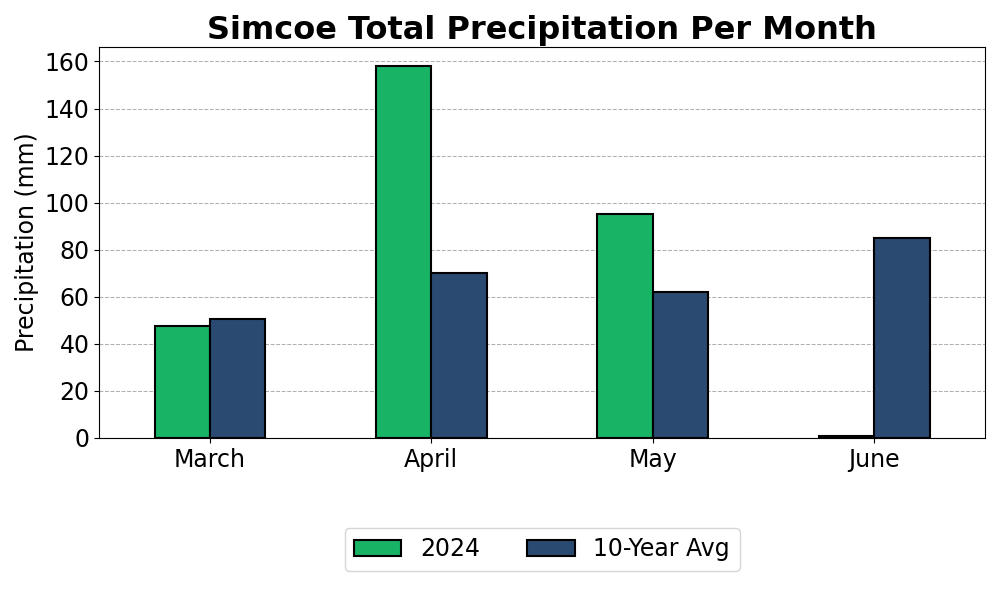
This first week of June, many Southern and Western counties such as Chatham-Kent, Huron, Middlesex, and Norfolk have experienced more rain than their 10-year average trend for the first week of June. Some Eastern counties such as Renfrew and Kemptville have received less rain than their 10-year average trend.
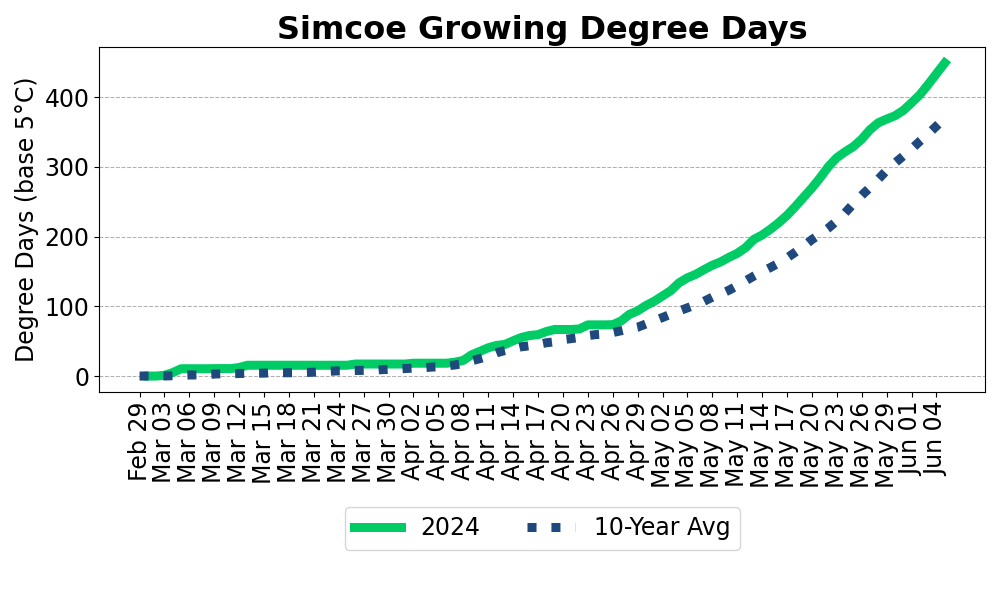
All counties continue to trend above their 10 year average GDD.
Crop Updates
Brassica Crops – Dig up wilted plants to inspect the roots for cabbage maggot larvae as larvae are likely to be actively feeding. Cimegra (active ingredient broflanilide, IRAC group 30) has been temporarily registered as an emergency use for cabbage maggot management for broccoli, Brussels sprouts, cabbage, and cauliflower for use in 2024. Broflanilide is a new active ingredient that can be applied as a post-planting drench banded spray. For best results, apply at peak egg laying activity based on sticky card counts or growing degree days for your region. Otherwise, Success (Group 5) and Verimark (Group 28) are registered as greenhouse tray drenches and Verimark can also be used as an in-furrow application in the transplant water at the time of transplanting. Imported cabbageworm, cabbage looper, and diamondback moths are active and slug, flea beetle, and cutworm damage has been observed.
To determine if the threshold for management has been met for imported cabbageworm, diamondback moth or cabbage looper (Figure 1), scout 5 plants in 5 locations and record the total number of each lepidopteran pest found (total number of egg or larvae found):
Multiply:
Diamondback moth x 0.2 = A
Imported cabbageworm x 0.5 = B
Cabbage looper x 1.0 = C
Then add and divide:
A+B+C divided by 25 = Cabbage Looper Equivalent
For cabbage, the threshold is 0.3 and for broccoli and cauliflower the threshold is 0.2.
| Diamondback Moth | Imported Cabbageworm | Cabbage Looper | |
| Eggs | -Scale-like eggs laid in small groups | -Yellow, bullet-shaped with ridges | -round, greenish-white |
| Larvae | -hairless | -Green larvae, short hairs, velvet-like appearance | -inchworms with thin white line along each side |
| Damage | -Create windows in leaves, do not consume through leaf | -Ragged holes and dark green frass not in piles | -Ragged holes and dark green frass in piles |
| Relative Damage (Cabbage Looper Equivalent) | 0.2 | 0.5 | 1.0 |
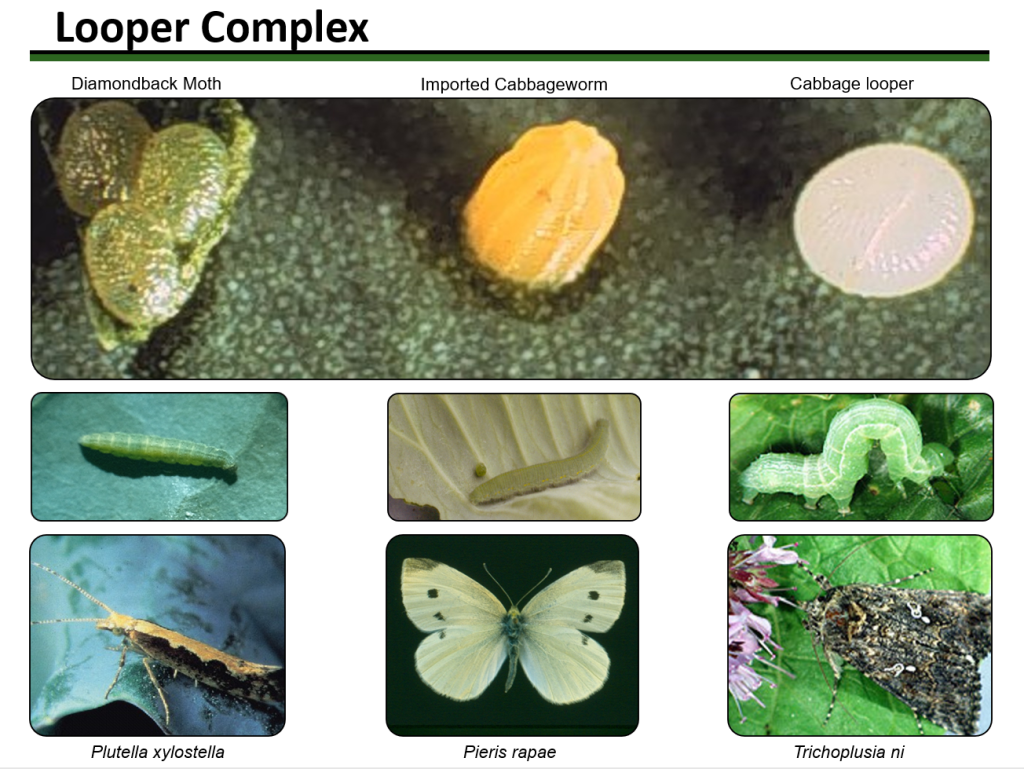
Figure 1. Diamondback Moth, Imported Cabbageworm, Cabbage Looper eggs, larvae and adult moths and butterfly.
Celery – Transplants are establishing. The thresholds for aster leafhopper and tarnished plant bug has been reached across the province with the exception of Thunder Bay. Dig up wilted plants and inspect the roots/plug for cutworm larvae. Scout for carrot weevils as they may be emerging around the field borders.
Garlic – The second flight of leek moth has started and with eggs hatching, be on the lookout for damage as hardneck cultivars are scaped over the next two weeks. Refer to this article for managing leek moth: Monitoring for Leek Moth. Snap scapes of hardneck cultivars as soon as possible to obtain the greatest yield benefit. Avoid using sickle bar mowers to remove scapes as they can easily spread garlic pathogens (including viruses) and often clip leaves during the scape removal process. Past research has shown that by accidentally removing one leaf when the scape was removed, bulb sizes were reduced by 13% and the yield was reduced by an average of 17.5%. The same trial showed that yield was greatly impacted as the number of leaves cut during mowing increased. If the top two leaves were cut, the yield was reduced by approximately 25%, almost outweighing any potential gains you would expect by removing the scape in the first place.
Onions – Some direct seeded fields are at the 4th leaf stage however most fields are averaging around the 2nd leaf stage. Onion maggot damage has been observed. Stake out 100 plants now to help determine how many onions make it to harvest. The pressure of thrips is low in direct seeded fields. Past research has shown that Movento 240 SC (group 23) has some residual activity that works better against larvae when it is applied earlier in the season. Once the spray threshold is reached, Movento 240 SC could be followed by two applications of Delegate (group 5) or Agri-Mek (group 6). Using a penetrating surfactant can be useful to maximize the effectiveness of products against thrips. Apply no more than two consecutive insecticides from the same IRAC group as thrips have a relatively short life cycle with multiple generations through the summer months and are at a high risk of developing insecticide resistance.
Pest Degree Day Forecasting
| County | Carrot Rust Fly | Onion Maggot | Carrot Weevil | Aster Leafhopper | Tarnished Plant Bug | Cabbage Maggot | Seedcorn Maggot | European Corn Borer |
| THRESHOLD | 329-395, 1399-1711 | 210-700, 1025-1515 | 138-156, 455+ | 128+ | 40+ | 314-398, 847-960, 1446-1604 | 200-350, 600-750, 1000-1150 | See legend below |
| Bruce*** | 555 | 482 | 303 | 205 | 98 | 357 | 482 | 165 |
| Essex* | 834 | 750 | 526 | 402 | 238 | 596 | 750 | 345 |
| Chatham-Kent* | 752 | 673 | 463 | 350 | 195 | 528 | 673 | 294 |
| Norfolk** | 702 | 621 | 405 | 292 | 152 | 471 | 621 | 240 |
| Huron*** | 630 | 554 | 353 | 245 | 129 | 415 | 554 | 199 |
| Wellington Centre** | 608 | 531 | 342 | 240 | 120 | 398 | 531 | 195 |
| Wellington North** | 595 | 521 | 334 | 236 | 122 | 392 | 521 | 192 |
| Simcoe*** | 590 | 517 | 330 | 227 | 112 | 386 | 517 | 180 |
| Durham*** | 641 | 563 | 365 | 258 | 132 | 426 | 563 | 211 |
| Peterborough | 586 | 510 | 322 | 219 | 104 | 380 | 510 | 175 |
| Kemptville*** | 641 | 565 | 382 | 282 | 159 | 436 | 565 | 237 |
| Sudbury*** | 461 | 402 | 256 | 177 | 89 | 301 | 402 | 142 |
| Timiskaming*** | 443 | 390 | 254 | 179 | 96 | 295 | 390 | 147 |
| Lambton** | 726 | 649 | 440 | 325 | 185 | 505 | 649 | 273 |
| Thunder Bay | 331 | 276 | 146 | 86 | 25 | 182 | 276 | 61 |
| Middlesex** | 741 | 660 | 446 | 330 | 186 | 513 | 660 | 278 |
| Renfrew | 627 | 554 | 372 | 277 | 157 | 427 | 554 | 234 |
*- Bivoltine region for ECB. First Peak Catch: 300-350 DD, Second Peak Catch 1050-1100 DD
**- Overlap region for ECB. First Peak Catch: 300-350 DD Second Peak Catch 650-700 DD, Third Peak Catch 1050-1100 DD
***-Univoltine region for ECB. Peak Catch 650-700 DD
Use these thresholds as a guide, always confirm insect activity with actual field scouting and trap counts
Select a region below for the latest weather, crop and pest degree day information:
Norfolk


Essex


Sudbury


Chatham-Kent


Peterborough


Huron


Durham


Thunder Bay


Bruce


Kemptville


Lambton


Middlesex


Renfrew


Simcoe
Wellington Centre


Wellington North


Timiskaming


Pingback: VCR – Vegetable Crop Report – July 4, 2024 – ONvegetables