
This will be the second growing season that Lorsban, or other chlorpyrifos products, will not be used to manage onion maggots in onions in Canada. Onion maggot management now relies predominantly on Sepresto 75 WS, a neonicotinoid seed treatment.
The seed treatment is working well protecting direct seeded onions from onion maggot larvae, but for onions started in the greenhouse for transplanting, the seed treatment may be worn off before or soon after they are transplanted in the field, leaving these newly transplanted onions at risk for large amounts of onion maggot damage.
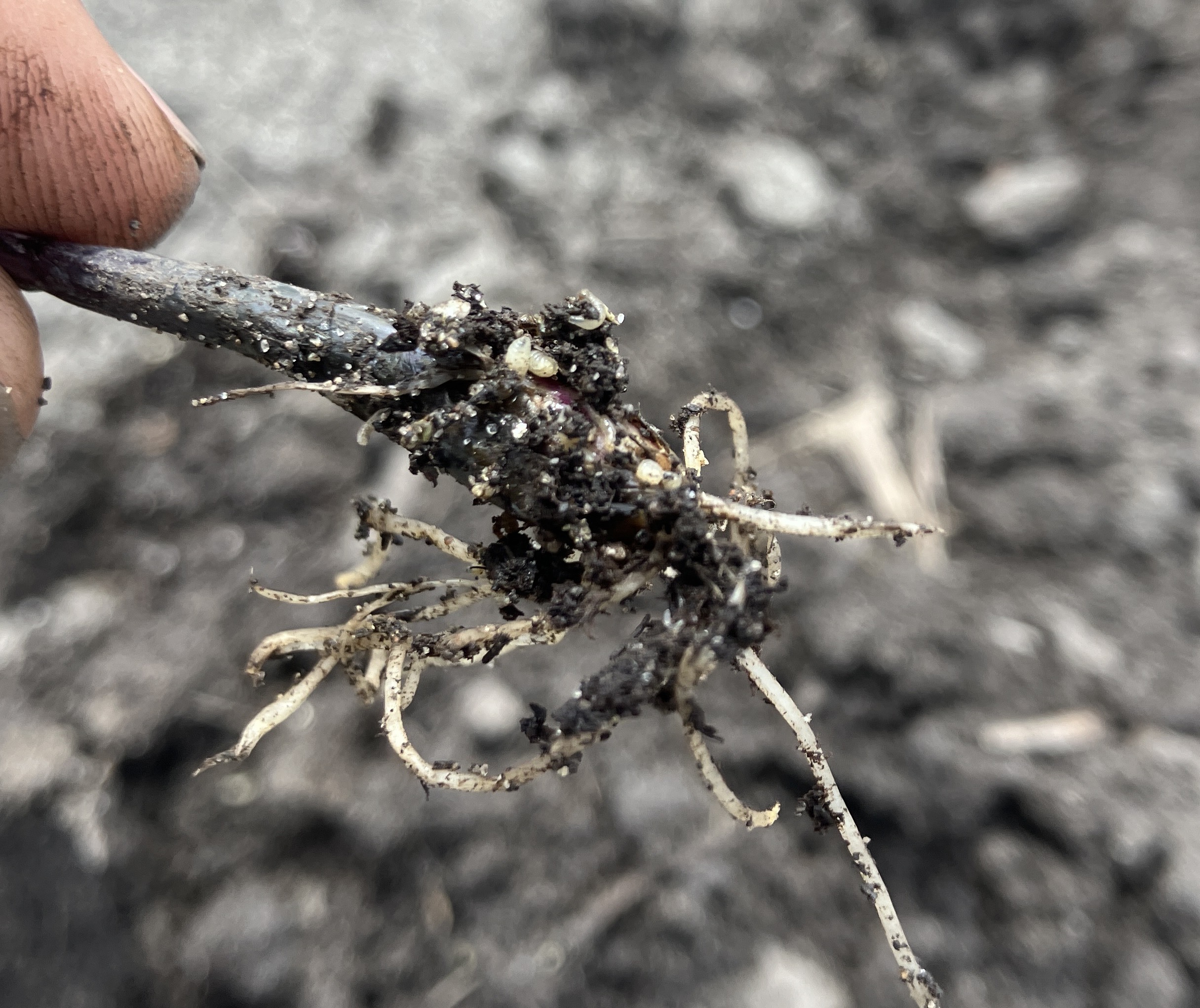
The onion maggot is the larval stage of the onion fly (Delia antiqua). A single larva can kill up to 20 plants early in the season and when populations are left unchecked, high onion maggot populations can reduce plant stands by over 50%. Early generations of onion maggot can kill onion transplants (Figure 1) and later generations can cause distorted growth and open wounds making it easier for fungal pathogens (like Fusarium) to gain entry and reduce the storage life of the bulb.

In Quebec, Sterile Insect Technology (SIT) has been used for over a decade to manage onion maggot on roughly 2500 acres of onions. In Ontario, four growers released sterile flies on a weekly basis to keep onion maggot in check in 2024. Flies are reared in a facility at the Phytodata Research Company in Sherrington, Quebec. Pupae are irradiated, dyed pink (to allow them to be distinguished from the wild population on sticky cards), and are shipped to release points where growers allow flies to emerge in emergence boxes and then release them on the edge of onion fields on a weekly basis.
In 2018 and 2019, before the phase-out of chlorpyrifos, two growers opted to release sterile flies as their onion maggot management strategy going forward and stopped using Lorsban or Sepresto 75 WS for onion maggot management. These two field sites in Scotland (Brant county) and Exeter/Thedford (Huron county) were monitored up until the 2024 field season. Sticky cards were monitored weekly and sterile flies could be differentiated from wild flies by the pink dye. Both of these locations had very different onion production systems, and both were several kilometers from other large onion fields. At the Scotland site, onions were transplanted and planted at a rate of 140,000 plants per acre while at the Exeter location, seeds were broadcast at a rate of ~8 million seeds per acre and harvested as onion sets.
The sterile male flies were released every week at these two locations, these sterile male flies mate with the wild female flies, resulting in unfertilized eggs that would never hatch. Once all of the onion fields in the area had sterile fly releases, the overall population of wild onion flies in the area plummeted over several years. At both locations where sterile flies were released, onion fields were transplanted or seeded yearly within ~3 km of the previous year’s field. Many years the fields were directly adjacent to the previous year’s field, yet populations of wild flies in 2022, 2023 and 2024 were all lower than the levels prior to 2022 (Figure 2). At harvest, fewer bulbs are found to have maggot damage, fewer bulbs are distorted, and as a result, there are fewer culls that are linked to onion maggot feeding.

The overall number of flies released per season depends on the current level of onion maggot pressure. Releases generally start at around 100,000 flies/ha/season and are reduced once levels fall to an acceptable rate. In Quebec, growers have been releasing an average of 16,000 flies/ha/season in dry onions and 25,000 flies/ha/season in green onions over the past several years.
Left unchecked, it may take several years for onion maggot populations to reach destructive levels where onion maggots cause 25-50% damage, but if it populations increase to those levels it will also take several years of sterile onion maggot releases to crash the population down to a manageable level that results in the same level of control as Lorsban (or other chlorpyrifos products) once provided.
In our two long term areas of study, sterile fly releases have completely replaced insecticides aimed at onion maggots at both locations, and the amount of onion maggot damage has dropped below levels that were observed in the last decade when chlorpyrifos was used.
If you are interested in applying this management strategy on your farm, please contact myself at travis.cranmer@ontario.ca, or Anne-Marie Fortier at afortier@phytodata.ca. While sterile fly releases generally start the first week of May, Phytodata requires time to rear and sterilize additional flies.
Pingback: VCR – Vegetable Crop Report – May 15th, 2025 – ONvegetables