
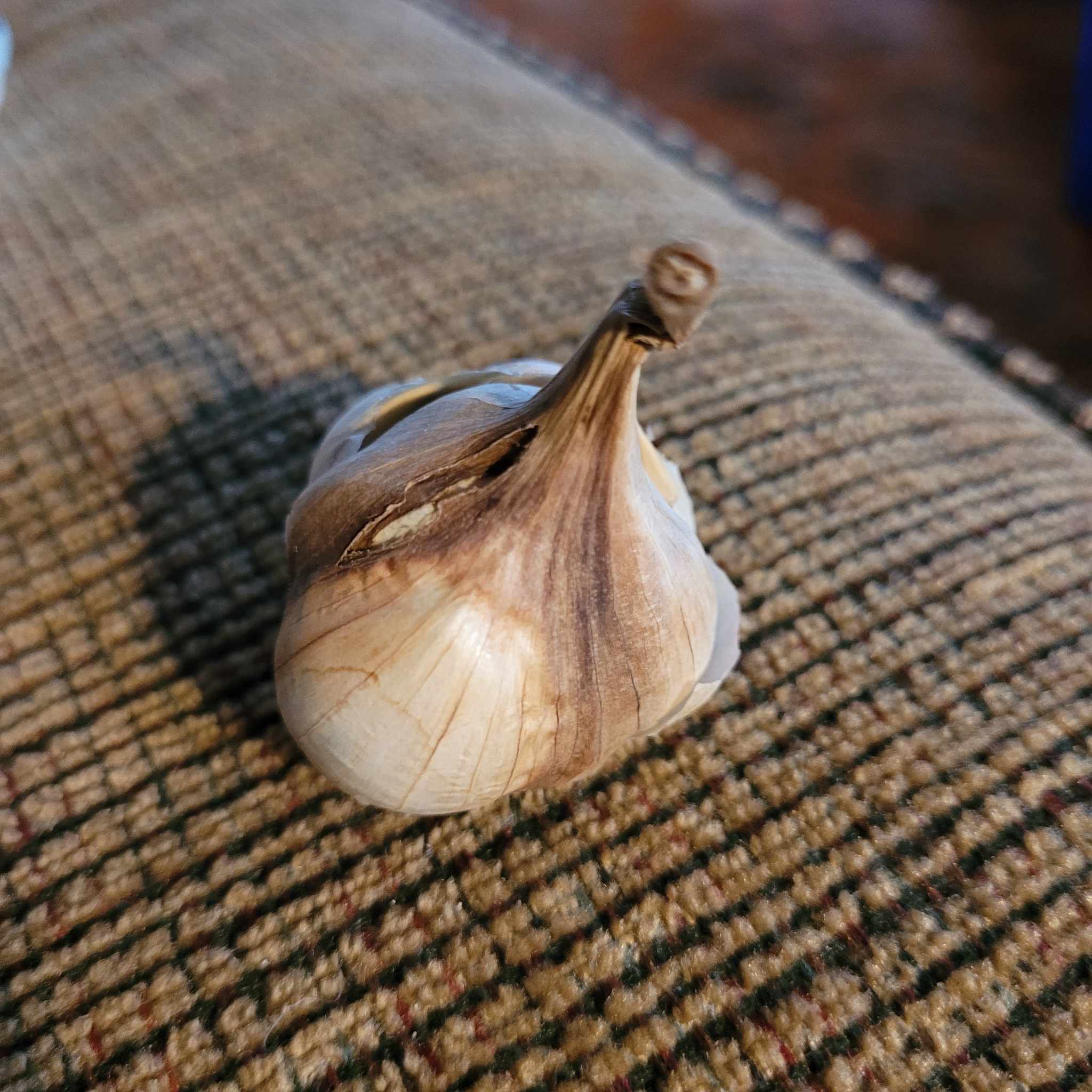
Over the past three years, the incidence of staining on garlic bulb wrappers has greatly increased in Ontario. In some fields, the necks of some bulbs at harvest did not shrink / dry down and, in severe cases, bulbs had internal rot above the cloves within the neck.
In other parts of the world, such as France and Japan, the staining and deterioration of the garlic bulb wrappers is referred to as café au lait which is generally caused by the pathogen Pseudomonas salomonii. Café au lait stains the bulb wrappers which in turn reduces the marketability of the bulbs. In addition, some bulb wrappers may break down prior to harvest. If there are fewer bulb wrappers remaining at harvest, it can make it difficult to clean the bulb since wrapper leaves are often knocked off during the cleaning process. Café au lait does not usually affect the formation of a bulb and clove differentiation.
Pseudomonas salomonii, the species of Pseudomonas responsible for Café au lait in other parts of the world has yet to be isolated from samples in Ontario. Other species of Pseudomonas have been isolated, and they cause a variety of symptoms. Pseudomonas cedrina causes staining of bulb wrappers similar to Pseudomonas salomonii (Figure 1). Pseudomonas marginalis has been isolated from bulbs where the bulb wrappers are nearly all rotted (Figure 2). This year, we have also found several fields with multiple plants showing fat necks (Figure 3), and rotten tissue within the stem above the cloves (Figure 4), and Pseudomonas fluorescens was isolated from these samples.


The movement of Pseudomonas to the field is likely due to the planting stock being contaminated with bacterial cells at planting. Research in France has shown that Pseudomonas favours rainy and wet autumns and winters. The bacterium establishes itself in the soil surrounding the clove and if conditions throughout the growing season continue to be moist, the pathogen is more likely to colonize the newly formed bulb and develop symptoms.1
Pseudomonas is a bacterial pathogen and there are no registered products that will likely prevent these symptoms from occurring. The answer lies in practicing different cultural management strategies. These management options may help to reduce Pseudomonas incidence going forward:
- Shorten cure time by removing excess moisture from the crop as quickly as possible; focus on reducing the relative humidity with dehumidifiers or air conditions and do not rely on heating ambient air to increase the water holding capacity of the air. In years where it is 95% relative humidity at harvest, heating the air to increase its water holding capacity is not as effective as a drier year
- Rogue out cloves with missing bulb wrappers, brown streaking or fat necks and do not use them as planting stock. Many growers have used unmarketable portions of their crop as planting stock in the past and this has inadvertently selected for increased incidences of Pseudomonas in years where the conditions are favourable for disease development
- Avoid poorly drained fields and plant in raised beds if there are concerns of flooding in any part of the growing season
- Avoid planting in headlands or areas that are in the shade; shade results in extended periods of leaf wetness which leads to better conditions for bacterial development
- Implement a 4-year crop rotation
- Avoid overhead irrigation; utilize drip irrigation instead
- Avoid any applications of nitrogen after the 5th leaf stage
Some of the management options above could be costly to implement. If planting stock with Pseudomonas cells are planted this fall, disease development at harvest will depend on the environmental conditions that occur after planting in the fall as well as the following spring and summer. If we have a drier field season, this pathogen may go away altogether even if none of the above management options are implemented. If it is another growing season with above average rainfall throughout most of the growing season, and none of the strategies above are implemented, it is likely that the symptoms will be more severe at harvest. Conditions have been favourable over the past two years, which is likely why we are seeing a rise in incidence of these Pseudomonas species this year.
“Pseudomonas is a bacterial pathogen and there are no registered products that will likely prevent these symptoms from occurring.”
Have you looked at using Ato Cide?
Recommended that you use ).5% solution and dip all your bulbs before planting. Before harvest use a 1% solution (at 10L per acre) to wipe out any soil borne pathogens. Ato Cide is certified organic and only leaves behind oxygen as a byproduct.
Hi Todd,
I have not looked at using Ato Cide. Can you share the Ato Cide PMRA / Health Canada label and any data you have on garlic? Have you seen any problems with germination after dipping cloves before planting?